


27 August 2026
: Case report 
Management Challenges of Interfering Cardiopulmonary Resuscitation‐Induced Consciousness in the Prehospital Setting: A Case Report
Unusual clinical course, Challenging differential diagnosis, Management of emergency care
Nicholas A. Wright ABEF 1*, John B. Patterson AEF 2, William S. Cox AEF 3
DOI: 10.12659/AJCR.952977
Am J Case Rep 2026; 27:e952977


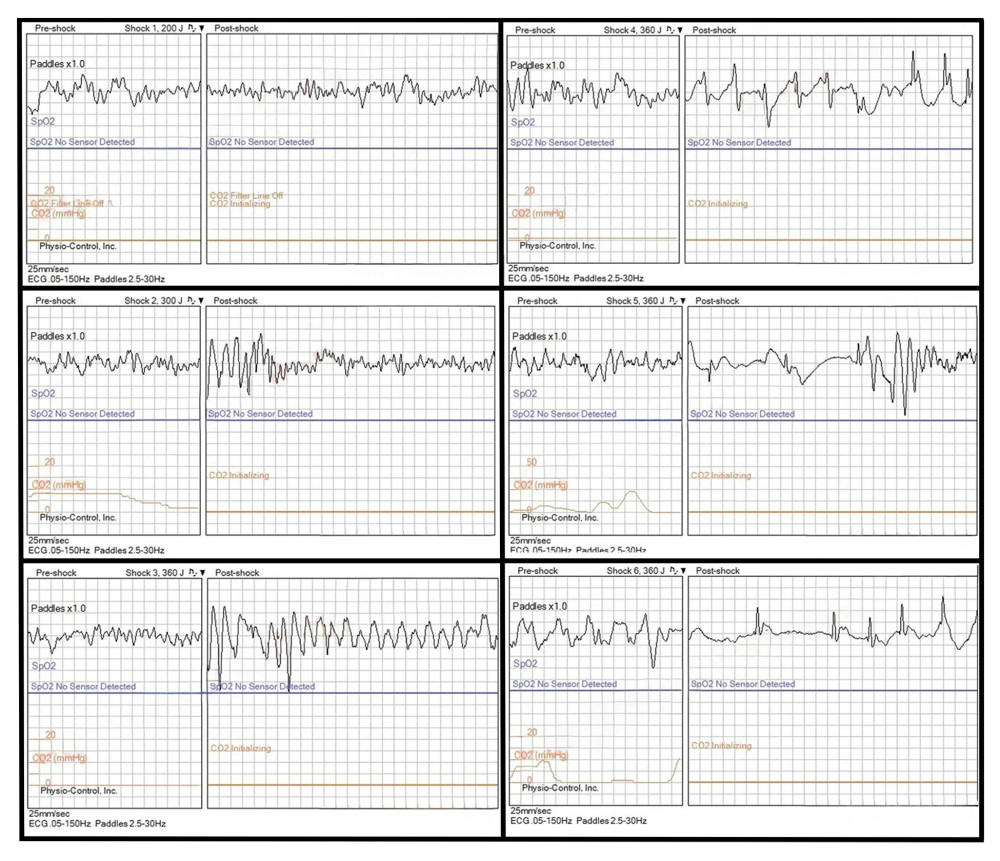
Figure 1 The initial defibrillation was delivered at 200 joules for ventricular fibrillation (top left). The second defibrillation was delivered at 300 joules for ventricular fibrillation (middle left). The third defibrillation was delivered at 360 joules for ventricular fibrillation, and the rhythm appears to have converted into ventricular tachycardia post-defibrillation (lower left). The fourth defibrillation was delivered at 360 joules for ventricular fibrillation, and the rhythm appears to have converted into an organized rhythm for a brief period of time post-shock (top right). The fifth defibrillation was delivered at 360 joules for ventricular fibrillation, and the rhythm appears to have once again converted into an organized rhythm for a brief period post-shock (middle right). The sixth defibrillation was delivered at 360 joules for ventricular fibrillation, and ROSC was obtained post-shock (lower right). ROSC, return of spontaneous circulation.