


11 September 2026: Articles 
Three Pediatric Cases of Accidental Lip Entrapment, Laceration, and Tongue Injury From Motorized Electric Nail Trimmers
Management of emergency care, Patient complains / malpractice
Mohammed Harb Hommady AEF 1*, Abdullah Ali Alqahtani E 1, Abdullatif Gashaa Almalki E 1, Abdullah M. Al-Saleh E 1,2,3, Lafi Saleh Alanazi AEF 4, Omar Essam Tarabzoni AEF 4, Abdulrahman Khaled Abaalkhail E 1, Abdullah Ahmad Alatawi EF 1DOI: 10.12659/AJCR.953929
Am J Case Rep 2026; 27:e953929


Abstract
BACKGROUND: Oral and perioral soft tissue injuries are common in early childhood, when oral exploration and imitation of adult grooming coincide with immature motor control. Motorized electric nail trimmers—battery-powered devices with a rotating element behind a small aperture—are commonly available; some reports have described entrapment of the tongue, facial skin, and eyelid in children. This report presents 3 pediatric cases of lip entrapment, laceration, and tongue injury caused by such devices.
CASE REPORT: Case 1: A 4-year-old girl presented with lower lip entrapment after activating a device against her mouth. Bedside release was unsuccessful; the fire and safety team isolated the battery and opened the casing, after which a deep lower lip laceration was irrigated and managed by primary closure. Case 2: A 3-year-old boy presented with upper lip entrapment in a similar device. After coordinated dismantling and reversal of the rotating mechanism, a laceration crossing the vermilion border was repaired under local anesthesia. Case 3: A 2-year-old girl sustained a tongue injury after contacting an activated device with her tongue. The device became detached, and a superficial abrasion of the tongue tip was managed conservatively. All 3 children healed without complications.
CONCLUSIONS: These cases illustrate that motorized electric nail trimmers can cause oral soft tissue injuries in young children, ranging from superficial abrasion to deep lip laceration requiring primary surgical repair. Avoidance of forceful traction, controlled release of the device, and subsequent wound repair were feasible management approaches. These cases do not establish the incidence or comparative risk of such injuries.
Keywords: Emergency Medicine, Lip, Nails, Pediatrics
Introduction
Young children explore objects with their mouths [1], imitate adult grooming behavior, and have not yet developed the motor control or hazard awareness needed to handle household devices safely. Oral and maxillofacial soft tissue injuries are consequently a recurring reason for emergency department (ED) visits in this age group [2]. The clinical spectrum ranges from superficial mucosal abrasions to deep lacerations involving the lips, tongue, teeth, and alveolar structures [3].
The lips and tongue are richly vascularized and functionally important for feeding and speech; thus, comparatively small wounds may bleed briskly and cause substantial distress [4]. Injuries crossing the vermilion border warrant particular care because malalignment at the mucocutaneous junction is conspicuous after healing [5]. General principles of pediatric wound management—including irrigation, assessment of wound depth and gaping, and selective primary closure—apply [6].
Entrapment injuries, in which tissue becomes mechanically trapped within an object, are a distinct subgroup. Fingertip and digit entrapments are well described [7], whereas intraoral entrapment has mainly been reported in isolated cases involving rigid containers. Classical examples include lingual ischemia after tongue entrapment in a glass bottle [8] and entrapment in an aluminum juice can [9]; approaches to releasing such entrapments have recently been reviewed [10].
Reports involving motorized electric nail trimmers are more recent and remain limited. Iio and Kishibe described 3 young children with cervicofacial skin entanglement caused by these devices, several of whom had been imitating shaving [11]. Fatani et al described a child whose tongue became entrapped in such a device [12]. AlSaedi et al reported 2 children who were treated in a Saudi pediatric ED: 1 had entrapment of the tongue tip and the other exhibited entrapment of the upper eyelid skin. In both cases, the device was released by dismantling it with the assistance of a hospital safety team, and neither child required wound repair [13]. In each of these published reports, the entrapped tissue was released without requiring surgical closure. Such reports provide comparators for the present cases.
This report describes 3 pediatric cases of accidental lip entrapment, laceration, and tongue injury caused by motorized electric nail trimmers; it outlines practical considerations involved in releasing the device and managing the resulting wounds.
Case Reports
CASE 1:
A previously healthy 4-year-old girl presented to our ED with her lower lip entrapped in a motorized electric nail trimmer. The incident had occurred 1 hour earlier, when she was playing unsupervised with the device, placed it against her lip, and unintentionally activated it. The rotating mechanism pulled mucosal tissue into the device, where it became firmly lodged. Her parents reported that the initial bleeding stopped after 5 minutes of direct pressure. She was initially evaluated at a nearby facility and referred to our center for definitive management. On arrival, the child was alert but distressed, unable to close her mouth, and crying because of pain. She was triaged as level 2 using the Canadian Triage and Acuity Scale (CTAS) and placed in a monitored bed. Vital sign assessment showed mild tachycardia attributed to pain; all other parameters were normal. The primary survey revealed no airway compromise. Careful examination revealed clinically significant edema and entrapment of the lower lip within the device. An initial removal attempt by the ED consultant was unsuccessful and was discontinued given the risk of further tissue trauma.
A coordinated plan was established involving the hospital fire and safety team for safe device removal and the pediatric plastic surgery team for wound management. The patient was kept calm through parental presence and gentle body wrapping. The battery was first isolated to prevent the rotating element from restarting during the procedure. Because the casing could not be manually opened while the device remained attached to the lip, the fire and safety team used a small handheld rotary cutting tool to divide the outer casing (Figure 1A). The lip and surrounding face were protected with moistened gauze; the patient’s eyes were shielded throughout the procedure. The cut was made away from entrapped tissue, and the tool was applied in short bursts to limit heat transfer. Once the casing had been opened, the internal wheels were manually rotated to release the lip (Figure 1B). After successful removal, a deep, jagged, full-thickness laceration with tissue loss was observed (Figure 1C). The plastic surgery team irrigated the wound, controlled the bleeding, and performed primary closure under local infiltration with 1 mL of 1% lidocaine plus epinephrine using 5-0 Vicryl Rapide sutures (Figure 1D). The wound was inspected for retained device fragments, and none were found. Oral amoxicillin-clavulanate (45 mg/kg/day in 2 divided doses) was prescribed for 5 days. The patient was discharged with analgesia (oral acetaminophen, 15 mg/kg every 6 hours as needed), instructions to follow a soft diet, and an outpatient follow-up appointment. The family was counseled at discharge to store motorized electric nail trimmers and similar devices out of the reach of children. At the 2-week follow-up, the wound showed excellent early healing without functional impairment.
CASE 2:
A previously healthy 3-year-old boy was brought to our ED by his parents after his upper lip had become entrapped in a motorized electric nail trimmer. The incident occurred approximately 2 hours before presentation, when the child, who was playing unsupervised with the device, placed it against his mouth and switched on the motor. The rotating mechanism pulled the central portion of the upper lip into the device, where it became tightly lodged. His parents reported immediate bleeding that stopped after a few minutes of compression. The family attempted to release the device at home without success, prompting them to seek medical care.
On arrival at the ED, the child appeared anxious, had moderate pain, was unable to approximate his lips, and was crying intermittently. He was triaged as CTAS level 2. Vital signs were within age-appropriate limits, except for mild tachycardia attributed to pain. Clinical examination revealed entrapment of the upper lip mucosa and skin between the rotating mechanism and the device’s plastic guard, along with substantial swelling and bruising (Figure 2A). Manual attempts at disengagement by the ED staff were deferred given the risk of tissue injury.
A multidisciplinary plan was established in coordination with the hospital fire and safety team and pediatric plastic surgery service. The patient was gently immobilized with parental assistance and comforted by his parents; comfort was also achieved through distraction, and no topical anesthetic was required before device release. After initial isolation of the battery, the fire and safety team carefully disassembled the trimmer housing and released the entrapped mucosa by reversing the wheel mechanism. Following device removal, a small upper lip laceration extending across the vermilion border was identified, with associated tissue contusion but no full-thickness defect (Figure 2B shows the device after removal, with blood staining at the aperture). The wound was copiously irrigated and repaired by the plastic surgery team under local anesthesia with 1 mL of 1% lidocaine plus epinephrine, using 6-0 Vicryl Rapide sutures with accurate realignment of the vermilion border. No retained device fragments were identified. Oral amoxicillin-clavulanate (45 mg/kg/day in 2 divided doses) was prescribed for 5 days.
The child tolerated the procedure well and was discharged with analgesia (oral acetaminophen, 15 mg/kg every 6 hours as needed), instructions to follow a soft diet, and close outpatient follow-up to monitor wound healing and cosmetic outcomes. The family was counseled at discharge to store motorized electric nail trimmers and similar devices out of the reach of children.
At the 1-week follow-up, the wound showed excellent early healing, with intact sutures, no signs of infection, and accurate alignment of the vermilion border. The family did not attend the subsequent scheduled appointment; therefore, no further data regarding the final scar appearance were available.
CASE 3:
A previously healthy 2-year-old girl was brought to our ED by her mother for evaluation of tongue bleeding. The mother reported that the child had been playing unsupervised with a motorized electric nail trimmer and accidentally inserted her tongue into the device while it was switched on. In contrast to the first 2 cases, the device did not remain attached to the child’s tongue; however, the incident resulted in sudden pain and active bleeding from the tongue tip, which was controlled at home with direct pressure. The family presented to the ED within 30 minutes of the incident.
On arrival, the child was crying mildly but was consolable, hemodynamically stable, and maintained normal oxygen saturation on room air. Vital signs were within normal limits for age. No drooling, stridor, or signs of airway compromise were observed. Oral examination revealed a small, superficial linear abrasion at the anterior tip of the tongue, without extension into the muscle or involvement of the lips, teeth, or buccal mucosa (Figure 3). No active bleeding was observed at the time of assessment. The wound was irrigated with normal saline, and oral acetaminophen (15 mg/kg) was administered for analgesia. The oral and maxillofacial surgery service was consulted; no suturing or surgical intervention was deemed necessary. The tongue was inspected for retained device fragments, and none were found.
The patient was observed in the ED for several hours, during which she tolerated oral fluids without difficulty and remained clinically stable. She was subsequently discharged with caregiver instructions regarding oral hygiene, a soft diet, analgesic use as needed, and signs of infection or delayed bleeding. The family was counseled about preventive measures, including secure storage of motorized electric nail trimmers and similar devices, to prevent recurrence. At telephone follow-up 3 days later, the abrasion had healed by secondary intention, without bleeding, infection, or feeding difficulties.
Discussion
The practical lesson from these 3 cases is that once oral soft tissue has been drawn into an activated motorized electric nail trimmer, continued traction on the device risks extending the injury. A safer approach is to render the device inert, dismantle it in a controlled manner, and then assess and repair the wound. The present cases add to the limited existing literature regarding soft tissue injuries caused by such devices [11–13] via descriptions of lip entrapment requiring primary surgical repair after release; previously reported cases of tongue, facial skin, and eyelid entrapment were resolved without wound closure. Three cases cannot establish that such injuries are becoming more frequent, and no such claim is made here.
In each of our cases, soft tissue had been drawn into the aperture of an activated device and caught by the rotating element. In published reports available to us, the devices were being used by children in ways for which they were not intended, rather than failing mechanically [11–13]. We did not examine the present devices for mechanical faults and thus cannot determine whether malfunction contributed to the injuries. In all 3 cases, the child was handling the device without direct adult supervision at the time of injury.
Our cases resemble published reports in terms of the mechanism and age of the affected children but differ regarding the tissues involved and management required after release. Iio and Kishibe described cervicofacial skin entanglement in 3 children; the tissue was released after sedation and lubrication without a need for surgical repair [11]. Fatani et al described tongue entrapment in an electronic nail device [12]. AlSaedi et al described tongue-tip and upper eyelid entrapment in 2 children; both devices were released by dismantling with the assistance of a hospital safety team, and the resulting minor injuries were allowed to heal without repair [13]. In the present Cases 1 and 2, the entrapped tissue involved the lip itself rather than the skin of the neck, face, or eyelid; both injuries required irrigation and primary closure after release. The resulting laceration was full-thickness with tissue loss in Case 1; in Case 2, the laceration was partial-thickness but crossed the vermilion border and required accurate realignment, a step with no counterpart in previously published cases. Case 3, in which the device spontaneously detached and caused only a superficial abrasion, more closely resembles the milder end of the published spectrum; its conservative management is consistent with evidence that small tongue lacerations in young children heal well without suturing [14]. Taken together, these observations suggest that the tissue involved can determine whether device release alone is sufficient or subsequent surgical repair is required; however, they do not establish the frequency of each injury pattern.
As illustrated by our case series, management of these injuries requires a coordinated multidisciplinary approach. Initial assessment in the ED is essential to determine injury severity and any need for specialized intervention. In Case 1, the ED, fire and safety team, and pediatric plastic surgery team collaborated to manage the treatment of a 4-year-old girl with lower lip entrapment who was triaged as CTAS level 2. The fire and safety team isolated the battery to prevent accidental reactivation, then divided the casing with a handheld rotary cutting tool while protecting the lip and eyes. After successful removal of the device, the plastic surgery team irrigated the wound and performed primary closure. This step warrants emphasis because the use of a powered cutting tool near a child’s face carries risks of thermal injury, fragment scatter, and inadvertent laceration. In our case, these risks were mitigated by first disconnecting the power source, shielding the eyes and adjacent tissues, cutting away from the entrapped lip, and working in short intervals.
Similarly, the ED, fire and safety team, and pediatric plastic surgery service collaborated in Case 2, which involved a 3-year-old boy with upper lip entrapment. The fire and safety team disassembled the trimmer housing and released the entrapped mucosa by reversing the wheel mechanism. After device removal, the laceration was irrigated and sutured under local infiltration anesthesia. In both Cases 1 and 2, release was facilitated by the availability of appropriate tools, personnel familiar with the device casing, non-pharmacological comfort measures, and sufficient time to proceed without haste. Neither child received systemic analgesia or anesthesia before device release. Comfort was maintained by parental presence, gentle immobilization, and distraction; local infiltration anesthesia was only used for wound repair after the device had been removed. The decision to involve a specialized team was based on entrapment complexity and the anticipated risk of additional tissue injury during removal.
Established guidelines for pediatric lacerations are consistent with the principles of wound management for entrapment-related injuries. The decision to suture a laceration depends on its depth, location, and degree of gaping [15]. In Case 1, the pediatric plastic surgery team performed primary closure of the deep lip laceration to promote healing and optimize the cosmetic outcome. This approach is consistent with recommendations from the Royal Children’s Hospital regarding surgical referral and suturing of large or full-thickness injuries [15]. In lip injuries involving the vermilion border, accurate approximation is crucial to achieve an optimal cosmetic outcome [5].
In all 3 cases, the child was handling the device without direct supervision, and each family was counseled at discharge to store such devices out of the reach of children. This approach is consistent with advice provided in published reports [11–13] and general guidance to prevent household injuries in young children [16]. AlSaedi et al similarly advised against attempts to remove the device at the scene because countertraction may worsen the laceration and increase bleeding [13], which aligns with our experience in Cases 1 and 2. Whether supervision or storage practices reduce the frequency of this particular injury cannot be determined from a series of 3 cases, and we make no claim regarding the relative effectiveness of any preventive measure. Moreover, although design features such as recessed apertures or contact-sensing cutoffs might intuitively reduce the risk, our cases provide no evidence to support this possibility, and we do not propose these features as validated solutions.
The present observations are limited to 3 preschool-aged children who sustained oral soft tissue injuries from motorized electric nail trimmers and were treated at a single center. Our report describes the injuries and corresponding management but does not establish how often such injuries occur, how the risk posed by these devices compares with that of other household items, or whether any particular release or repair approach is superior to another. Whether the same considerations apply to entrapment at other body sites, other rotating household devices, or population-level prevention strategies is beyond the scope of this report.
This report has some limitations. First, it describes 3 children treated at a single center; therefore, no inference regarding injury frequency or risk can be drawn. Second, follow-up was short, and in Case 2, the family did not attend appointments beyond the 1-week follow-up; therefore, the final scar appearance after vermilion border repair is unknown. Third, wound dimensions were not recorded in the medical record at the time of presentation; thus, injuries are described qualitatively rather than in terms of measured length or surface area. Fourth, the devices were not examined for mechanical faults, and no formal device identification or model comparison was performed. Finally, the release techniques described were determined by the equipment and personnel available at our center at the time. They were not compared with alternative techniques, and their generalizability remains unknown.
Conclusions
In these 3 preschool-aged children, motorized electric nail trimmers caused oral soft tissue injuries ranging from a superficial tongue abrasion managed conservatively to a deep lower lip laceration that required device dismantling and primary surgical repair. The practical lesson is that once tissue becomes entrapped within the device, further traction risks extending the injury. A safer approach is to render the device inert by isolating the battery, dismantle it in a controlled manner with technical assistance when available, and assess and repair the wound only after release. Coordinated management involving emergency, technical, and surgical personnel was feasible; it was followed by uncomplicated healing. Unlike previously reported cases of tongue, facial skin, and eyelid entrapment, 2 of our 3 cases required primary wound closure after release, indicating that clinicians should anticipate that lip entrapment may require surgical repair in addition to device removal. Caregivers should be aware that these devices can cause injury when handled by children without supervision. Our observations are limited to 3 cases from a single center and do not establish the frequency of such injuries or evaluate potential device modifications.
Figures
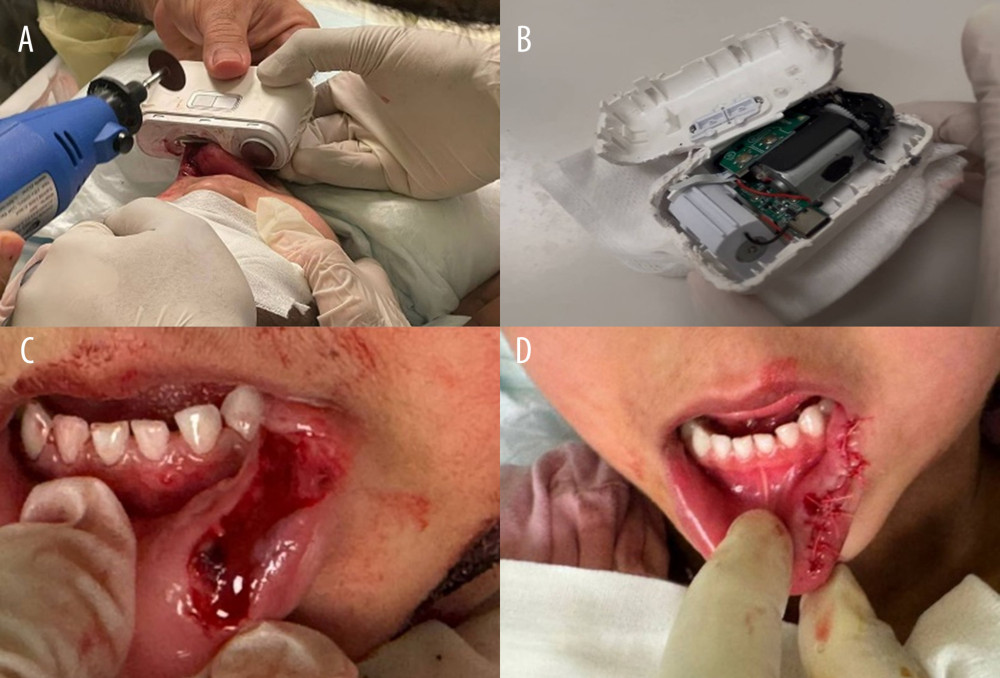 Figure 1. Case 1—Lower lip entrapment in a motorized electric nail trimmer in a 4-year-old girl and subsequent repair.(A) The device attached to the lower lip in the emergency department, with the lip drawn into the aperture on the underside of the device. The battery had already been disconnected, and a handheld rotary cutting tool (left) was applied to the outer casing away from the entrapped tissue; the surrounding face was protected by gauze. (B) The same device after the casing had been opened, showing the exposed battery and circuit board; the internal wheels were then manually rotated to release the lip. (C) The lower lip immediately after release, showing a deep, jagged, full-thickness laceration with tissue loss. (D) The same lip after irrigation and primary closure with 5-0 absorbable sutures under local infiltration anesthesia. All images were obtained during the index emergency department visit.
 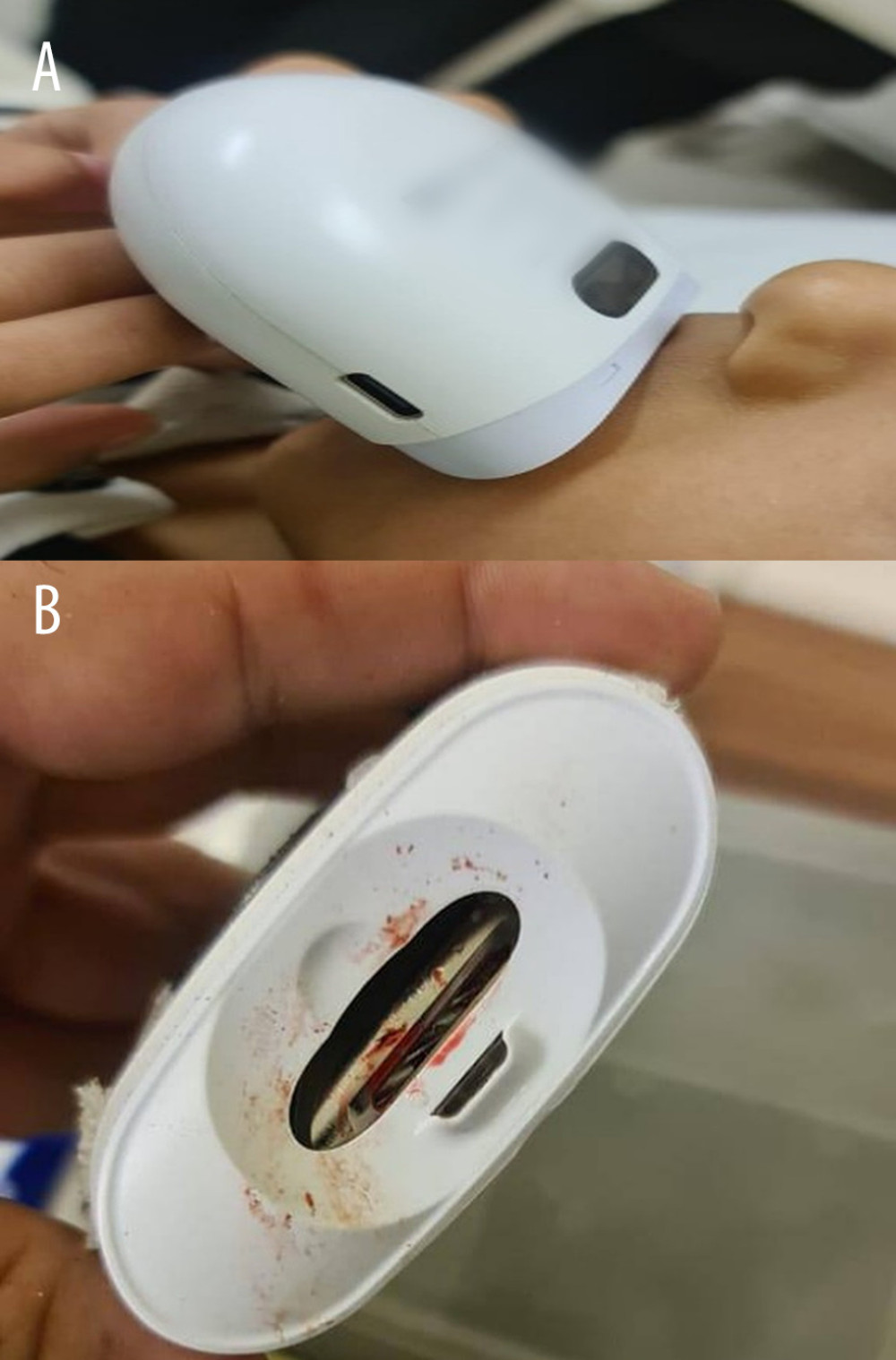 Figure 2. Case 2—Upper lip entrapment in a motorized electric nail trimmer in a 3-year-old boy.(A) The device attached to the upper lip on arrival at the emergency department, with the lip held between the rotating mechanism and the plastic guard of the device; manufacturer markings on the casing have been obscured. (B) The same device after removal, viewed from the underside, showing the oval aperture and rotating element within the aperture; blood staining is visible at the aperture margin. Both images were obtained during the index emergency department visit.
 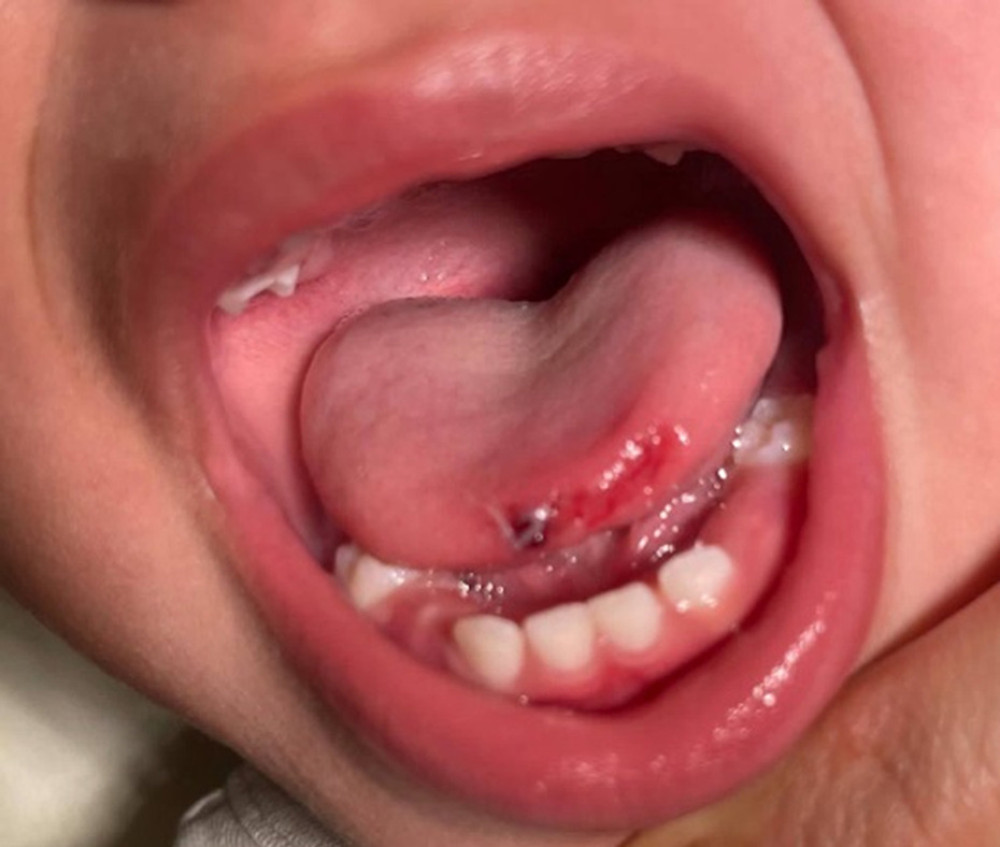 Figure 3. Case 3—Superficial tongue abrasion from a motorized electric nail trimmer in a 2-year-old girl.A superficial linear abrasion at the anterior tip of the tongue, without extension into the underlying muscle or involvement of the lips, teeth, or buccal mucosa. The device had become detached before arrival. The image was obtained during the index emergency department visit; the wound was managed conservatively without suturing.
 References
1. Tulve NS, Suggs JC, McCurdy T, Frequency of mouthing behavior in young children: J Expo Anal Environ Epidemiol, 2002; 12(4); 259-64
2. Park KH, Song JM, Hwang DS, A clinical study of emergency room visits for oral and maxillofacial lacerations: J Korean Assoc Oral Maxillofac Surg, 2015; 41(5); 246
3. Keels MASection on Oral Health, American Academy of Pediatrics, Management of dental trauma in a primary care setting: Pediatrics, 2014; 133(2); e466-76
4. Piccinin MA, Zito PM, Anatomy, head and neck, lips: StatPearls [Internet], 2026, Treasure Island (FL), StatPearls Publishing Available from:https://www.ncbi.nlm.nih.gov/books/NBK507900/
5. Campo TM, Lip laceration and vermilion border repair: Adv Emerg Nurs J, 2021; 43(3); 206-11
6. Knapp JF, Updates in wound management for the pediatrician: Pediatr Clin North Am, 1999; 46(6); 1201
7. Reid S, Duncan MJ, Interventions for treating fingertip entrapment injuries in children: Paediatr Child Health, 2016; 21(1); 27-28
8. Guha SJ, Catz ND, Lingual ischemia following tongue entrapment in a glass bottle: J Emerg Med, 1997; 15(5); 637-38
9. Bank DE, Diaz L, Behrman DA, Tongue entrapment in an aluminum juice can: Pediatr Emerg Care, 2004; 20(4); 242-43
10. Pershad AR, Gorelik D, Preciado D, Zalzal HG, Resolving tongue entrapment: A comprehensive review with case report: OTO Open, 2024; 8(4); e70044
11. Iio K, Kishibe S, Electric nail clipper entanglement injury: A new form of injury in young children: Am J Emerg Med, 2025; 92; 253e1-e2
12. Fatani B, Alshehri NA, Alsagr HA, Alkindi M, An unusual case of tongue entrapped in an electronic nail clipper: A case report: Cureus, 2024; 16(5); e60744
13. AlSaedi AS, Bhat AA, AlRashed RMA, Soft tissue entrapment in the electronic nail clipper in children: Case series: Ind J Emerg Med, 2024; 10(4); 231-34
14. Seiler M, Massaro SL, Staubli G, Schiestl C, Tongue lacerations in children: To suture or not?: Swiss Med Wkly, 2018; 148; w14683
15. Royal Children’s Hospital Melbourne: Lacerations. Clinical Practice Guidelines [Internet], Melbourne, RCH Available from:https://www.rch.org.au/clinicalguide/guideline_index/lacerations/
16. Ablewhite J, Peel I, McDaid L, Parental perceptions of barriers and facilitators to preventing child unintentional injuries within the home: A qualitative study: BMC Public Health, 2015; 15; 280
Figures
Figure 1. Case 1—Lower lip entrapment in a motorized electric nail trimmer in a 4-year-old girl and subsequent repair.(A) The device attached to the lower lip in the emergency department, with the lip drawn into the aperture on the underside of the device. The battery had already been disconnected, and a handheld rotary cutting tool (left) was applied to the outer casing away from the entrapped tissue; the surrounding face was protected by gauze. (B) The same device after the casing had been opened, showing the exposed battery and circuit board; the internal wheels were then manually rotated to release the lip. (C) The lower lip immediately after release, showing a deep, jagged, full-thickness laceration with tissue loss. (D) The same lip after irrigation and primary closure with 5-0 absorbable sutures under local infiltration anesthesia. All images were obtained during the index emergency department visit.Figure 2. Case 2—Upper lip entrapment in a motorized electric nail trimmer in a 3-year-old boy.(A) The device attached to the upper lip on arrival at the emergency department, with the lip held between the rotating mechanism and the plastic guard of the device; manufacturer markings on the casing have been obscured. (B) The same device after removal, viewed from the underside, showing the oval aperture and rotating element within the aperture; blood staining is visible at the aperture margin. Both images were obtained during the index emergency department visit.Figure 3. Case 3—Superficial tongue abrasion from a motorized electric nail trimmer in a 2-year-old girl.A superficial linear abrasion at the anterior tip of the tongue, without extension into the underlying muscle or involvement of the lips, teeth, or buccal mucosa. The device had become detached before arrival. The image was obtained during the index emergency department visit; the wound was managed conservatively without suturing. In Press
Case report 
Am J Case Rep In Press; DOI: 10.12659/AJCR.953543
Case report 
Am J Case Rep In Press; DOI: 10.12659/AJCR.954216
Case report 
Am J Case Rep In Press; DOI: 10.12659/AJCR.954932
Case report 
Am J Case Rep In Press; DOI: 10.12659/AJCR.954146
Most Viewed Current Articles
07 Dec 2021 : Case report
28,712,695
DOI :10.12659/AJCR.934347
Am J Case Rep 2021; 22:e934347
06 Dec 2021 : Case report  180,721
DOI :10.12659/AJCR.934406
Am J Case Rep 2021; 22:e934406
21 Jun 2024 : Case report
124,419
DOI :10.12659/AJCR.944371
Am J Case Rep 2024; 25:e944371
08 May 2026 : Case report
95,462
DOI :10.12659/AJCR.952158
Am J Case Rep 2026; 27:e952158