


05 September 2026: Articles 
Primary Care Recognition of Rabson-Mendenhall Syndrome Despite Absence of Classical Diabetic Symptoms
Challenging differential diagnosis, Rare disease
Abdullah Al Eisa ABE 1, Atheer Humoud Aldayhani ABDEF 2*DOI: 10.12659/AJCR.953067
Am J Case Rep 2026; 27:e953067


Abstract
BACKGROUND: Rabson-Mendenhall syndrome (RMS) is an extremely rare autosomal recessive disorder caused by pathogenic variants in the insulin receptor gene, leading to severe insulin resistance and compensatory hyperinsulinemia. Classical features include acanthosis nigricans, non-obese or underweight body habitus, hirsutism, dental abnormalities, dysmorphic features, and variable growth abnormalities. Early recognition may be difficult when the initial presentation is dominated by non-specific symptoms rather than classical metabolic complaints.
CASE REPORT: A 10-year-old Saudi girl presented to a family medicine clinic with intermittent bilateral leg pain and excessive hunger, without polyuria or polydipsia. Examination revealed extensive acanthosis nigricans, moderate hirsutism, deep voice, high-arched palate, and dental enamel defects. Laboratory evaluation showed severe hyperinsulinemia with insulin level of 3522.5 µU/mL, elevated HbA1c of 8.4% (68 mmol/mol), and biochemical hyperandrogenism. Although RMS is classically associated with growth restriction, the patient was tall for age and had a family history of tall stature, requiring cautious interpretation of growth-related findings. Whole-exome sequencing confirmed a homozygous pathogenic insulin receptor variant (c.433C>T, p.Arg145Cys), establishing the diagnosis of RMS. Treatment included vitamin D supplementation, metformin, basal-bolus insulin therapy, dapagliflozin, home glucose monitoring, diabetes education, dietary counseling, and multidisciplinary follow-up. Glycemic control remained suboptimal despite treatment intensification, reflecting the severe receptor-level insulin resistance associated with RMS.
CONCLUSIONS: In this patient, marked acanthosis nigricans, severe hyperinsulinemia, hyperglycemia, and hyperandrogenic features supported evaluation for a genetic insulin resistance syndrome despite the absence of classical diabetic symptoms.
Keywords: Acanthosis Nigricans, Rabson-Mendenhall Syndrome, Hyperinsulinism, Insulin Resistance
Introduction
Rabson-Mendenhall syndrome (RMS) is an extremely rare autosomal recessive disorder caused by pathogenic variants in the insulin receptor gene, leading to severe insulin resistance and hyperinsulinemia [1]. Patients with RMS typically present with growth abnormalities, including intrauterine and postnatal growth restriction, along with insufficient subcutaneous fat, acanthosis nigricans, hirsutism, dysmorphic facial features, pineal hyperplasia, and premature or dysmorphic teeth [1–3]. However, early recognition may be challenging when the initial presentation is dominated by non-specific symptoms rather than classical metabolic complaints. We report a pediatric case of RMS initially presenting to a family medicine clinic with bilateral leg pain and excessive hunger, without polyuria or polydipsia. This case highlights the importance of considering severe genetic insulin resistance in children with acanthosis nigricans, hyperphagia, hyperandrogenic features, and unexplained metabolic abnormalities, even when the presenting complaint appears unrelated to endocrine disease.
Case Report
BIRTH AND DEVELOPMENTAL HISTORY:
The patient was born at full term via spontaneous vaginal delivery following an unremarkable pregnancy, with no history of polyhydramnios or oligohydramnios. Birth weight was 3 kg, and she was discharged in stable condition. Her developmental milestones were appropriate for her age.
FAMILY HISTORY:
The parents are non-consanguineous. She has 3 healthy brothers, and there was 1 prior miscarriage. A family history of tall stature was noted in her brother and maternal uncles. There was no family history of early menarche, adrenal disorders, or similar presentations. However, there is a family history of developmental delay and learning disabilities, type 1 diabetes mellitus, and malignancy (lymphoma).
PHYSICAL EXAMINATION:
The patient was tall for her age, with a height of 159.3 cm (> 97th percentile) and a weight of 43.4 kg (body mass index [BMI] 17 kg/m2), with normal vital signs. Extensive generalized hyperpigmentation consistent with acanthosis nigricans was noted over the face, neck, axillae, cubital fossae, and inguinal regions with moderate hirsutism over the body. Her voice was deep. Mild coarse facial features were suspected but were not pronounced, with a high-arched palate. Dental examination revealed enamel defects. No abnormalities were observed in the nails, and there was no evidence of lipoatrophy.
LABORATORY INVESTIGATIONS:
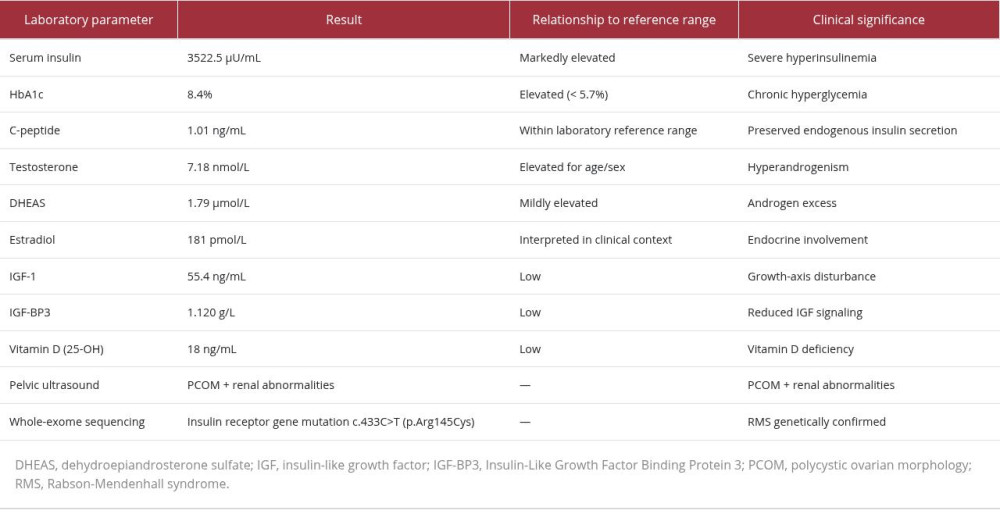
Initial investigations were selected to evaluate the main clinical possibilities raised by the presentation, including metabolic disease, endocrine dysfunction, vitamin D deficiency, and severe insulin resistance. The initial laboratory investigations revealed significantly elevated serum insulin levels (3522.5 μU/mL), indicating severe insulin resistance. Glycated hemoglobin (HbA1c) was increased at 8.4%, consistent with chronic hyperglycemia. The inappropriately normal C-peptide level (1.01 ng/mL) indicated that endogenous insulin synthesis was maintained in spite of hyperinsulinemia.
Endocrine profiling showed elevated estradiol (181 pmol/L) and testosterone (7.18 nmol/L), with normal luteinizing hormone and follicle-stimulating hormone (1.58 IU/L and 3.39 IU/L, respectively). Dehydroepiandrosterone sulfate (DHEAS) was mildly elevated at 1.79 μmol/L. Insulin-like growth factor 1 (IGF-1) was low (55.4 ng/mL), with a corresponding reduction in IGF-binding protein 3 (1.120 g/L). Although RMS is classically associated with intrauterine or postnatal growth restriction, this patient was tall for her age and had a family history of tall stature. Therefore, the low IGF-1 and IGF-binding protein 3 levels were interpreted cautiously as possible biochemical evidence of growth-axis disturbance in the context of severe insulin receptor dysfunction, despite the patient’s tall stature and the absence of the short stature commonly associated with RMS.
Liver function tests were within normal limits (alanine aminotransferase 19 U/L, aspartate aminotransferase 21 U/L, total bilirubin 11.1 μmol/L). Lipid profile was unremarkable, with total cholesterol of 4.3 mmol/L and triglycerides at 0.50 mmol/L. Serum 25-hydroxy vitamin D was low (18.0 ng/mL).
A pelvic ultrasound was performed to evaluate the abdominal and pelvic structures. The pelvic ultrasound showed bilateral kidney enlargement and echogenicity. These findings suggested possible medical renal disease and required clinical correlation. Moreover, stable bilateral grade 1 hydronephrosis was also observed. Additionally, both ovaries were enlarged with multiple small peripheral follicles, consistent with polycystic ovarian morphology, which may reflect an endocrine manifestation often associated with severe insulin resistance in genetic syndromes. Aside from debris that warranted urinalysis correlation, no acute abnormalities were identified in the urinary bladder.
Several differential diagnoses were considered. Vitamin D deficiency was considered because of the bilateral leg pain and low 25-hydroxy vitamin D level; however, it did not explain the severe hyperinsulinemia, hyperglycemia, acanthosis nigricans, hirsutism, and hyperandrogenism. Type 2 diabetes mellitus was also considered because of the elevated HbA1c, but the patient’s non-obese body habitus, markedly elevated insulin level, dental findings, and syndromic features suggested a genetic form of severe insulin resistance. Rheumatologic or neuromuscular causes of leg pain were less likely because there was no joint swelling, morning stiffness, fever, weakness, abnormal movements, or neurological deficits. Therefore, genetic testing was pursued to confirm the suspected diagnosis.
Based on the patient’s clinical presentation of severe insulin resistance and hyperandrogenism, a multidisciplinary team evaluation was undertaken involving pediatric endocrinology, clinical genetics, and dermatology. Considering the combination of clinical characteristics, a genetic form of insulin resistance was suspected. Whole-exome sequencing confirmed a homozygous pathogenic variant in the insulin receptor gene (c.433C>T, p.Arg145Cys), establishing the diagnosis of RMS. Key clinical and laboratory findings are summarized in Table 1.
TREATMENT AND OUTCOME:
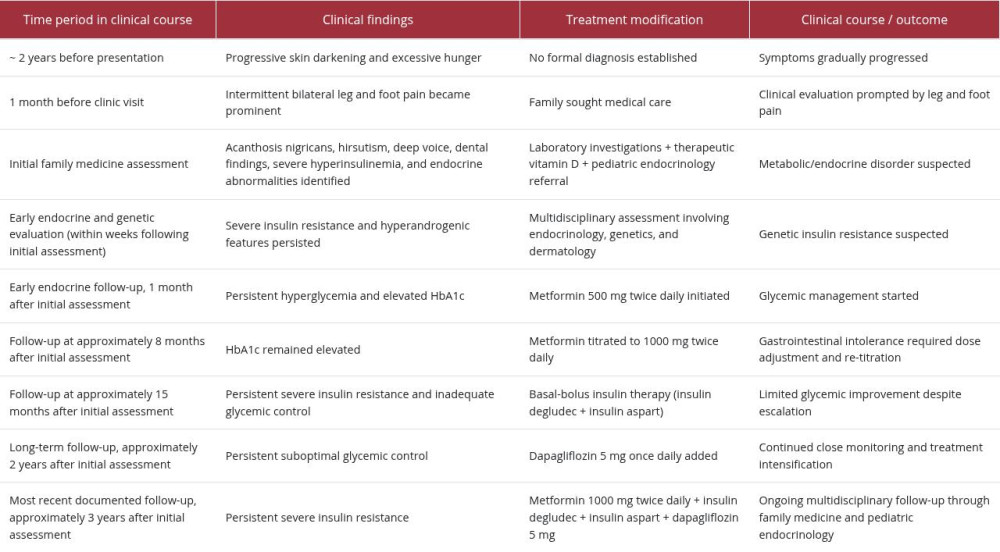
The patient was initially managed with a therapeutic dose of vitamin D supplementation and safety netting by a family medicine physician. Upon referral to pediatric endocrinology, she was started on metformin 500 mg orally twice daily, alongside structured home blood glucose monitoring before meals (2 hours postprandially and at bedtime). Due to persistently elevated HbA1c, the metformin dose was titrated up to 1000 mg twice daily. However, the patient experienced gastrointestinal side effects during metformin escalation, leading to a temporary dose reduction and gradual re-titration as tolerated.
As glycemic control remained inadequate, insulin therapy was introduced. She was initiated on a basal-bolus regimen with insulin degludec administered at bedtime and insulin aspart before meals, with doses adjusted based on weight and glycemic trends. Over time, total daily insulin requirements increased slightly. Despite this escalation, HbA1c remained elevated, prompting the addition of dapagliflozin 5 mg once daily as an adjunct therapy. Throughout this period, diabetes education, dietary counseling, lifestyle modifications, and ongoing support were provided at each clinical encounter.
Glycemic control remained suboptimal despite multiple adjustments in oral medications and insulin dosing. HbA1c values showed persistent elevation with only modest improvement following treatment intensification. This clinical course reflects the intrinsic insulin resistance associated with RMS and the difficulty in achieving glycemic targets.
During follow-up, treatment was adjusted according to home glucose readings, HbA1c trends, medication tolerance, and the risk of adverse effects. Metformin escalation was limited by gastrointestinal intolerance, requiring temporary dose reduction and gradual re-titration. No severe treatment-related adverse events were documented during follow-up, but close monitoring was continued because of the complexity of treatment in severe genetic insulin resistance.
Follow-up remains shared between family medicine and pediatric endocrinology. Her current regimen includes metformin 1000 mg twice daily, dapagliflozin 5 mg once daily, insulin degludec as basal coverage, and insulin aspart with meals. Ongoing review focuses on glycemic trends, medication tolerance, renal findings, and diabetes education because long-term control remains difficult in severe genetic insulin resistance. The chronological clinical course and treatment progression are summarized in Table 2.
Discussion
RMS is part of the spectrum of inherited insulin receptor disorders caused by pathogenic variants in the insulin receptor gene, which is located on chromosome 19 and encodes the insulin receptor involved in insulin binding and downstream signaling [4,5]. Different insulin receptor gene mutations have previously been described in patients with severe insulin resistance [6,7]. Earlier reports described familial insulin-resistant diabetes with multiple somatic anomalies and pineal hyperplasia [8]. Impaired insulin receptor signaling leads to severe insulin resistance, compensatory hyperinsulinemia, hyperglycemia, acanthosis nigricans, and endocrine manifestations such as hyperandrogenism [1,7,9]. Classical clinical features include non-obese or underweight body habitus, acanthosis nigricans, hirsutism, dental abnormalities, dysmorphic features, and variable growth abnormalities [1–3,9].
The patient had several recognized features of RMS, including severe hyperinsulinemia, acanthosis nigricans, hirsutism, deep voice, dental enamel defects, hyperglycemia, and a homozygous pathogenic insulin receptor variant. The noteworthy aspect of this case is therefore the initial presentation in a family medicine clinic, where bilateral leg pain and excessive hunger were the main complaints, and classical diabetic symptoms, such as polyuria and polydipsia, were absent.
The leg pain deserves comment because musculoskeletal symptoms are not prominent in most descriptions of RMS. One previously published case reported joint pain and generalized weakness in a patient with RMS [10]. This observation does not prove that leg pain was directly caused by RMS, but it supports considering musculoskeletal discomfort as a possible under-recognized feature in some patients with severe insulin resistance syndromes. In the present patient, vitamin D deficiency may have contributed to the leg pain; however, the coexistence of extensive acanthosis nigricans, hyperphagia, hyperandrogenism, severe hyperinsulinemia, and non-obese body habitus prompted evaluation for an underlying genetic insulin resistance syndrome.
Although RMS is commonly associated with intrauterine or postnatal growth restriction, our patient was tall for her age and had a family history of tall stature. This finding does not exclude RMS, as height may be influenced by familial growth pattern and phenotypic variability. The low IGF-1 and IGF-binding protein 3 levels were therefore interpreted as possible biochemical evidence of growth-axis disturbance in the context of insulin receptor dysfunction, rather than interpreting the patient’s tall stature as a direct contradiction to the diagnosis.
Management of RMS remains challenging because there are no standardized curative treatments or randomized controlled trials for this rare condition [9,11]. Treatment is mainly supportive and aims to improve glycemic control, reduce metabolic complications, and provide long-term multidisciplinary surveillance. In this patient, metformin was used to improve insulin sensitivity, while basal-bolus insulin was added because of persistent hyperglycemia. Insulin therapy may have limited effectiveness in RMS because the primary defect is at the insulin receptor level. Dapagliflozin was added as adjunctive therapy to improve glycemic control through an insulin-independent mechanism. This should be interpreted as an individualized treatment adjustment rather than a novel or pioneering therapeutic strategy.
Several practical points can be drawn from this case. Severe genetic insulin resistance should be considered in non-obese children with marked acanthosis nigricans, hyperinsulinemia, hyperglycemia, and hyperandrogenic features, even when the initial complaint is non-specific. Musculoskeletal complaints may delay recognition if they are interpreted in isolation. Genetic testing is useful when the clinical and biochemical phenotype suggests severe insulin receptor dysfunction. Finally, multidisciplinary follow-up is important because glycemic control may remain suboptimal despite metformin, insulin, adjunctive therapy, diabetes education, and lifestyle counseling.
Conclusions
RMS is an extremely rare genetic insulin resistance syndrome with a recognizable but variable phenotype. In our patient, the first point of care was a family medicine clinic, and the presenting concerns were bilateral leg pain and excessive hunger rather than polyuria or polydipsia. The diagnosis was supported by severe acanthosis nigricans, hyperinsulinemia, hyperglycemia, hyperandrogenism, dental abnormalities, and confirmation of a pathogenic insulin receptor variant. The persistent elevation of HbA1c despite metformin, basal-bolus insulin, dapagliflozin, lifestyle counseling, and close follow-up illustrates the difficulty of glycemic control in receptor-level insulin resistance. Future studies are needed to determine whether musculoskeletal complaints are under-recognized in RMS and to assess emerging treatment options for severe insulin receptor disorders.
References
1. Longo N, Wang Y, Pasquali M, Progressive decline in insulin levels in Rabson-Mendenhall syndrome: J Clin Endocrinol Metab, 1999; 84(8); 2623-29
2. Taylor SI, Lilly Lecture: Molecular mechanisms of insulin resistance. Lessons from patients with mutations in the insulin-receptor gene: Diabetes, 1992; 41(11); 1473-90
3. Accili D, Molecular defects of the insulin receptor gene: Diabetes Metab Rev, 1995; 11(1); 47-62
4. Yang-Feng TL, Francke U, Ullrich A, Gene for human insulin receptor: Localization to site on chromosome 19 involved in pre-B-cell leukemia: Science, 1985; 228(4700); 728-31
5. Lee J, Pilch PF, The insulin receptor: Structure, function, and signaling: Am J Physiol, 1994; 266(2 Pt 1); C319-34
6. Kadowaki T, Kadowaki H, Accili D, Taylor SI, Substitution of lysine for asparagine at position 15 in the alpha-subunit of the human insulin receptor: J Biol Chem, 1990; 265(31); 19143-50
7. Taylor SI, Kadowaki T, Kadowaki H, Mutations in insulin-receptor gene in insulin-resistant patients: Diabetes Care, 1990; 13(3); 257-79
8. West RJ, Lloyd JK, Turner WM, Familial insulin-resistant diabetes, multiple somatic anomalies, and pineal hyperplasia: Arch Dis Child, 1975; 50(9); 703-8
9. Gong W, Chen W, Dong J, Liao L, Rabson-Mendenhall syndrome: Analysis of the clinical characteristics and gene mutations in 42 patients: J Endocr Soc, 2024; 8(8); bvae123
10. Gosavi S, Sangamesh S, Ananda Rao A, Insulin, insulin everywhere: A rare case report of Rabson-Mendenhall syndrome: Cureus, 2021; 13(2); e13126
11. Hassan I, Altaf H, Yaseen A, Rabson-Mendenhall syndrome: Indian J Dermatol, 2014; 59(6); 633
In Press
Case report 
Am J Case Rep In Press; DOI: 10.12659/AJCR.953543
Case report 
Am J Case Rep In Press; DOI: 10.12659/AJCR.954216
Case report 
Am J Case Rep In Press; DOI: 10.12659/AJCR.954932
Case report 
Am J Case Rep In Press; DOI: 10.12659/AJCR.954146
Most Viewed Current Articles
07 Dec 2021 : Case report
28,712,695
DOI :10.12659/AJCR.934347
Am J Case Rep 2021; 22:e934347
06 Dec 2021 : Case report  180,721
DOI :10.12659/AJCR.934406
Am J Case Rep 2021; 22:e934406
21 Jun 2024 : Case report
124,419
DOI :10.12659/AJCR.944371
Am J Case Rep 2024; 25:e944371
08 May 2026 : Case report
95,462
DOI :10.12659/AJCR.952158
Am J Case Rep 2026; 27:e952158