


14 August 2026: Articles 
Systemic Reaction After Centipede Bite in a Child: Diagnostic Challenges Between Toxic and Hypersensitivity Mechanisms
Unusual clinical course, Challenging differential diagnosis, Management of emergency care
Takatoshi Murakami E 1, Yusuke Miyashita AE 1*, Toshihiko Nonaka B 1, Mika Ogata D 2, Kimitoshi Nakamura D 2DOI: 10.12659/AJCR.953155
Am J Case Rep 2026; 27:e953155


Abstract
BACKGROUND: Centipede (Scolopendra subspinipes) envenomation typically causes localized pain and swelling and is generally considered a self-limited condition. However, systemic reactions resembling hypersensitivity responses, such as generalized urticaria and respiratory discomfort, have occasionally been reported. Differentiation of toxic venom effects from immunologically mediated reactions remains challenging, particularly in pediatric patients, because standardized diagnostic testing for centipede venom allergy is unavailable.
CASE REPORT: A previously healthy 4-year-old girl developed generalized urticaria, facial swelling, pallor, and transient respiratory discomfort approximately 10 minutes after sustaining multiple nocturnal centipede bites indoors. Cutaneous manifestations appeared at sites distant from the bite locations, a finding potentially compatible with a systemic reaction rather than a purely localized toxic effect. Vital signs remained stable, and symptoms improved spontaneously without pharmacologic intervention. Hymenoptera-venom-specific IgE testing performed several weeks later showed weak positivity (class 1), although the patient had no prior history of bee or wasp stings. Considering the possibility of recurrent systemic reactions in environments where repeated exposure may occur, an epinephrine auto-injector was prescribed for emergency preparedness.
CONCLUSIONS: This case highlights diagnostic challenges in distinguishing toxic and allergic mechanisms after arthropod envenomation in children. The persistence of venom-specific IgE beyond the acute phase may suggest susceptibility to venom-related hypersensitivity, rather than a transient response to envenomation. Even when symptoms resolve spontaneously and definitive diagnostic confirmation is unavailable, careful clinical assessment and risk stratification remain essential. Preparedness for possible future anaphylaxis should be considered when systemic symptoms occur after arthropod exposure.
Keywords: Anaphylaxis, Case Reports, Child, Envenomation, Toxicology
Introduction
Centipede (
Centipede venom contains multiple bioactive components, including histamine, serotonin, phospholipase A2-like enzymes, and peptide toxins capable of activating inflammatory pathways and nociceptive signaling [5,6]. Because commercial diagnostic tests for centipede venom are unavailable, confirmation of an IgE-mediated allergy is difficult. We describe a toddler who developed rapid-onset multisystem symptoms after multiple centipede bites, highlighting important diagnostic and clinical implications. Distinguishing between toxic and allergic mechanisms is clinically important because it directly influences risk assessment and decisions regarding preventive management in pediatric patients.
Case Report
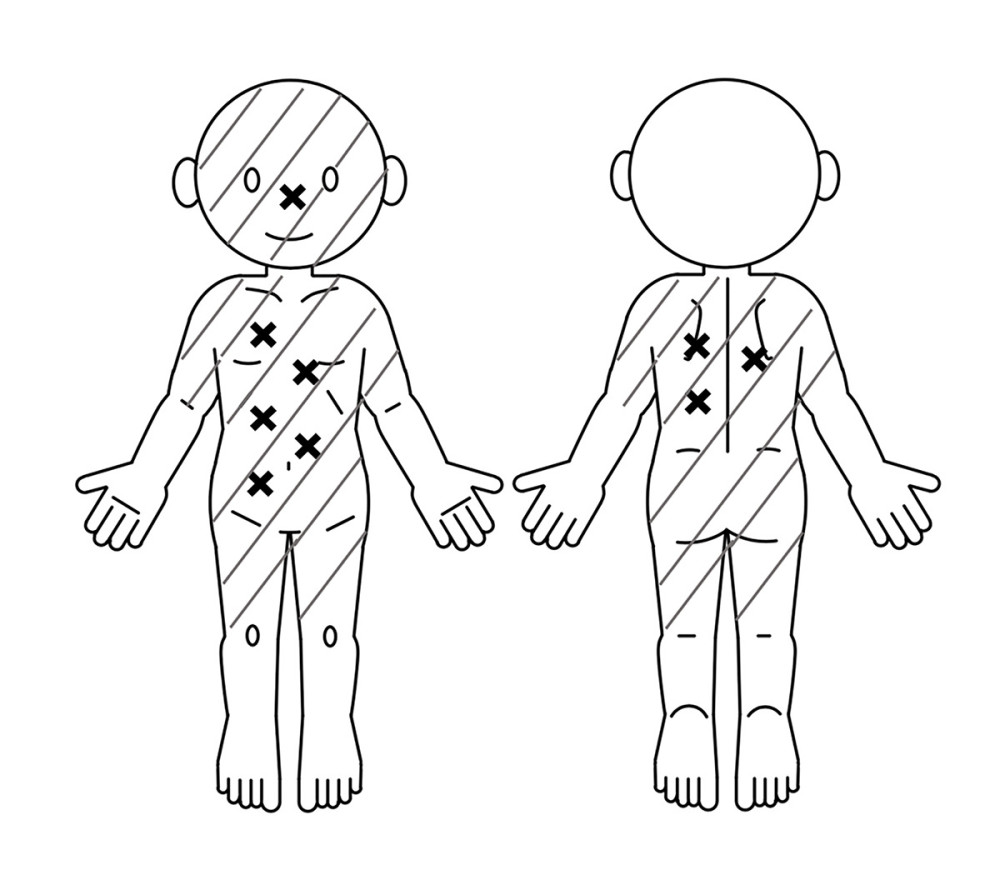
A previously healthy 4-year-old girl complained of pain, and her family reported witnessing a centipede biting her while she was sleeping indoors. The incident occurred in her home in Amakusa City, Kumamoto Prefecture, Japan, a rural area where centipedes are commonly encountered indoors. The patient sustained a total of 8 bites: 2 on the chest, 3 on the abdomen, 2 on the back, and 1 on the nose. Approximately 10 minutes after the bites, she developed generalized urticaria involving the face, including the eyelids, as well as the chest, abdomen, back, upper arms, and thighs. The distribution of bite sites and cutaneous symptoms is illustrated in Figure 1. Pain at the bite sites was mild. Approximately 10 minutes later, she complained of respiratory discomfort and developed pallor. Her parents contacted emergency services.
On arrival, her vital signs were stable (blood pressure, 93/50 mm Hg; heart rate, 103 bpm; peripheral oxygen saturation, 100% on room air; temperature, 36.4 °C). Her symptoms began improving spontaneously during transport. She was monitored for several hours and discharged without complications. Clinical photographs were not obtained because the cutaneous symptoms had largely resolved by the time of medical evaluation. Additionally, the distribution of skin lesions was based on the history provided by the family, given that no direct clinical observation was made at the peak of symptoms. Therefore, a schematic illustration was used to represent the reported distribution. No formal environmental investigation was performed, and no specimen was collected to confirm the causative organism.
Laboratory evaluation performed several weeks later showed normal blood cell counts and eosinophil levels (4.0%; 214.8/μL). The total IgE level was slightly elevated at 130 IU/mL (reference range, 0–120 IU/mL). Hymenoptera-venom-specific IgE testing revealed weak positivity to yellow hornet and paper wasp venom (class 1; 0.41 and 0.37 UA/mL, respectively), whereas honeybee venom-specific IgE findings were negative. The patient had no history of allergies or prior bee or wasp stings.
Given the rapid onset of multisystem symptoms and the possibility of future reactions, an epinephrine auto-injector was prescribed.
Discussion
A key diagnostic challenge in this case was distinguishing toxic envenomation effects from an immunologically mediated hypersensitivity reaction. Although most centipede bites cause localized symptoms, systemic reactions occur in approximately 5% of cases [7]. Distinguishing toxic venom effects from IgE-mediated hypersensitivity is often difficult. Centipede venom contains multiple vasoactive and inflammatory substances, including histamine, serotonin, and phospholipase-like enzymes, which can induce systemic manifestations independent of prior sensitization [8]. Conversely, true IgE-mediated centipede allergy has been demonstrated in a limited number of adult cases using specialized skin and basophil activation tests [9].
Children may exhibit different arthropod venom response patterns compared with adults [10]. Higher cutaneous mast cell density, increased vascular reactivity, and an immature regulatory immune network can amplify both toxic and allergic manifestations [11]. Pediatric anaphylaxis often presents with prominent cutaneous and respiratory symptoms, whereas hypotension is less common [12]. Therefore, spontaneous improvement does not exclude anaphylaxis in children [13].
In the present case, several clinical features were consistent with a systemic reaction beyond a purely local toxic effect. Generalized urticaria occurring at sites distant from the bites suggested systemic mediator release, rather than localized venom diffusion. The onset of generalized symptoms within approximately 10 minutes of envenomation further supports the possibility of an immediate-type systemic reaction. The temporal association between exposure and symptom onset, combined with respiratory discomfort, was consistent with hypersensitivity-like presentations described in previous reports. The transient respiratory symptoms observed in our case could theoretically have been attributable to pain or distress associated with multiple bites, particularly in a young child. However, the patient reported only mild pain at the bite sites, and respiratory symptoms developed approximately 10 minutes after the initial exposure rather than immediately. This temporal pattern, along with the presence of generalized urticaria and facial swelling, makes a pain-related response less likely and supports the interpretation of a systemic reaction. Nevertheless, definitive confirmation of the underlying mechanism was not possible.
Severe systemic reactions to insect stings have been associated with underlying mast cell disorders, including mastocytosis. Thus, evaluation for such conditions may be considered in patients presenting with recurrent or severe anaphylactic reactions. However, in the present case, the patient experienced a single episode that resolved spontaneously; she had no history of similar reactions and exhibited no clinical features suggestive of mast cell disease. Accordingly, routine screening for mastocytosis was not pursued.
Because diagnostic reagents for centipede venom are unavailable, Hymenoptera-venom-specific IgE testing was performed as an indirect assessment of potential cross-reactivity. Centipede venom contains hyaluronidase and proteolytic enzymes that overlap with Hymenoptera allergens [1]. The weak positivity observed in this case may reflect cross-reactivity, rather than true Hymenoptera sensitization [14]. The persistence of venom-specific IgE several weeks after the event suggests that the elevation was unlikely to represent a transient post-envenomation phenomenon. This finding may indicate an underlying susceptibility to venom-related hypersensitivity and raises the possibility of recurrent systemic reactions after future exposures. Although indirect and limited, these findings provide the only objective laboratory evidence suggestive of a possible IgE-mediated mechanism.
Centipedes are nocturnal arthropods that frequently enter homes in warm, humid climates. Epidemiological studies from Sri Lanka and other tropical regions have reported substantial rates of indoor nocturnal bites [15]. Centipede bites are typically isolated events; however, multiple bites can occur when the animal remains in contact with the skin, particularly during indoor or nocturnal exposures. In rural regions of Japan, including Amakusa City, centipedes are commonly found indoors, especially in warm and humid environments. In the present case, the occurrence of multiple bites was likely related to prolonged contact during sleep. The patient was bitten while sleeping, highlighting that children in endemic regions may face ongoing exposure risk even within their homes.
This case has some limitations. First, sensitization to centipede venom could not be confirmed because no diagnostic tests are currently available. Second, sensitization to Hymenoptera venom is relatively common in the general population and may not necessarily be linked to clinical reactivity; false-positive results are not uncommon. Therefore, the presence of low-level venom-specific IgE in this case should be interpreted with caution and cannot be considered definitive evidence of cross-reactivity or allergic sensitization.
Given the risk of nocturnal indoor exposure and the possibility of cross-reactive venom sensitivity, the prescription of an epinephrine auto-injector was appropriate. This case underscores the need for heightened awareness of centipede-induced reactions in children and the importance of preparedness for anaphylaxis in endemic regions.
Conclusions
This case highlights the diagnostic challenges associated with a possible systemic hypersensitivity-like reaction after centipede envenomation in children. When systemic symptoms develop rapidly after exposure and involve areas beyond the bite sites, careful clinical assessment and risk stratification are essential to guide management, including consideration of an epinephrine auto-injector. Although the temporal association strongly suggested centipede envenomation as the cause of the reaction, definitive confirmation of the causative organism and the underlying immunological mechanism was not possible. Further research is needed to better define the mechanisms underlying systemic reactions to centipede venom and to establish reliable diagnostic strategies.
References
1. Harada S, Yoshizaki Y, Natsuaki MThree cases of centipede allergy: Analysis of cross reactivity with bee allergy: Arerugi, 2005; 54(11); 1279-84 [in Japanese]
2. Yildiz A, Biceroglu S, Yakut N, Acute myocardial infarction in a young man caused by centipede sting: Emerg Med J, 2006; 23(4); e30
3. Golden DB, Insect sting anaphylaxis: Immunol Allergy Clin North Am, 2007; 27(2); 261-72
4. Nayak CA, Naik VR, Kurdikar SU, Pereira MI, Systemic anaphylaxis following centipede envenomation: A case report and review of literature: J Family Med Prim Care, 2024; 13(11); 5418-20
5. Ombati R, Luo L, Yang S, Lai R, Centipede envenomation: Clinical importance and the underlying molecular mechanisms: Toxicon, 2018; 154; 60-68
6. Undheim EA, Fry BG, King GF, Centipede venom: Recent discoveries and current state of knowledge: Toxins (Basel), 2015; 7(3); 679-704
7. Niruntarai S, Rueanpingwang K, Othong R, Patients with centipede bites presenting to a university hospital in Bangkok: A 10-year retrospective study: Clin Toxicol (Phila), 2021; 59(8); 721-26
8. Dribin TE, Motosue MS, Campbell RL, Overview of allergy and anaphylaxis: Emerg Med Clin North Am, 2022; 40(1); 1-17
9. Washio K, Masaki T, Fujii S, Anaphylaxis caused by a centipede bite: A “true” type-I allergic reaction: Allergol Int, 2018; 67(3); 419-20
10. Wang Y, Allen KJ, Suaini NHA, The global incidence and prevalence of anaphylaxis in children in the general population: A systematic review: Allergy, 2019; 74(6); 1063-80
11. Nguyen SMT, Rupprecht CP, Haque A, Mechanisms governing anaphylaxis: Inflammatory cells, mediators, endothelial gap junctions and beyond: Int J Mol Sci, 2021; 22(15); 7785
12. Madsen CN, Melchiors BB, Mosbech H, Pediatric perioperative hypersensitivity in Denmark: A 20-year retrospective analysis: Pediatr Allergy Immunol, 2025; 36(4); e70079
13. Tedner SG, Asarnoj A, Thulin H, Food allergy and hypersensitivity reactions in children and adults—A review: J Intern Med, 2022; 291(3); 283-302
14. Uasuf CG, D’Anna C, Di Sano C, Immune response to mosquito allergens is associated with cross-reactive bee venom components: The importance of cross-reactive carbohydrate determinants (CCDs) in the bee-mosquito syndrome: Eur Ann Allergy Clin Immunol, 2025 [Online ahead of print]
15. Kularatne SAM, Shahmy S, Rathnayake SS, Dawson AH, Clinico-epidemiology of arthropod stings and bites in primary hospitals of North Western province of Sri Lanka: Clin Toxicol (Phila), 2018; 56(10); 880-85
In Press
Case report 
Am J Case Rep In Press; DOI: 10.12659/AJCR.953543
Case report
Am J Case Rep In Press; DOI: 10.12659/AJCR.954216
Case report 
Am J Case Rep In Press; DOI: 10.12659/AJCR.954932
Case report 
Am J Case Rep In Press; DOI: 10.12659/AJCR.954146
Most Viewed Current Articles
07 Dec 2021 : Case report
28,712,695
DOI :10.12659/AJCR.934347
Am J Case Rep 2021; 22:e934347
06 Dec 2021 : Case report  180,721
DOI :10.12659/AJCR.934406
Am J Case Rep 2021; 22:e934406
21 Jun 2024 : Case report
124,419
DOI :10.12659/AJCR.944371
Am J Case Rep 2024; 25:e944371
08 May 2026 : Case report
95,462
DOI :10.12659/AJCR.952158
Am J Case Rep 2026; 27:e952158