


11 August 2026: Articles 
Dialysis-Associated Acquired Cystic Kidney Disease as a Cause of Progressive Renal Hemorrhage in a Patient Receiving Hemodialysis: A Case Report
Management of emergency care
Xiao Huang ABEF 1, Meihan Chen BDFG 1, Dayong Hu ACDG 1*DOI: 10.12659/AJCR.953308
Am J Case Rep 2026; 27:e953308


Abstract
BACKGROUND: Acquired cystic kidney disease is a known complication in patients receiving hemodialysis and one cause of spontaneous hemorrhage. Spontaneous hemorrhage of acquired cystic kidney disease in patients receiving hemodialysis was previously described as a rare condition with a poor prognosis. This report describes the case of a 68-year-old man with dialysis-associated acquired cystic kidney disease presenting with spontaneous intracystic hemorrhage.
CASE REPORT: A 68-year-old man on maintenance hemodialysis for 2 years presented with right lower abdominal and lumbar pain 5 hours after hemodialysis. Physical examination revealed percussion tenderness over the right renal region. The patient had normal coagulation functions and used low-molecular-weight heparin for anticoagulation during hemodialysis. Both the conservative management and artery embolization with digital subtraction angiography were unsuccessful. Dynamic monitoring of hemoglobin concentration indicated a downward trend. Computed tomography of the abdomen revealed progressive enlargement of the hematoma. Subsequently, the patient underwent a right nephrectomy. Postoperative gross pathological finding verified spontaneous hemorrhage caused by rupture of dialysis-associated acquired cystic kidney disease. Postoperatively, the level of hemoglobin remained stable.
CONCLUSIONS: This case with spontaneous hemorrhage of dialysis-associated acquired cystic kidney disease highlights the need for surveillance in patients receiving hemodialysis. Prompt surgical intervention is beneficial for patients with dialysis-associated acquired cystic kidney disease presenting with spontaneous hemorrhage and a persistent decline of hemoglobin.
Keywords: Hemodialysis Units, Hospital, Hemorrhage, kidney, Nephrectomy, Case Reports
Introduction
Hemodialysis is the most common form of kidney replacement therapy worldwide, accounting for approximately 69% of all kidney replacement therapy and 89% of all dialysis treatment [1]. Patients receiving hemodialysis are generally believed to have an increased risk of hemorrhage due to platelet dysfunction, altered platelet-vessel wall interactions, and the factors that inhibit normal platelet adhesion and aggregation [2]. One prospective cohort study demonstrated that the risk of bleeding was 1.5-fold higher in patients receiving hemodialysis compared with those receiving peritoneal dialysis [3].
Spontaneous hemorrhage is a rare clinical syndrome characterized by an acute onset of spontaneous renal hemorrhage into the subcapsular, perirenal, and/or pararenal spaces, without a history of antecedent trauma, and may present with Lenk’s triad, which consists of acute flank or abdominal pain [4]. Acquired renal cystic disease (ACKD), as a known complication of hemodialysis, is a possible cause of spontaneous hemorrhage [5,6]. Spontaneous hemorrhage of ACKD in patients receiving hemodialysis was previously described as a rare condition with a poor prognosis [7–9].
This report describes the case of a 68-year-old man with dialysis-associated ACKD presenting with spontaneous intracystic hemorrhage. This report is intended to (1) heighten clinical vigilance for ACKD rupture when spontaneous hemorrhage occurs in patients receiving hemodialysis and (2) offer clinical experience to guide therapeutic decisions for patients with dialysis-associated ACKD with spontaneous intracystic hemorrhage.
Cases Report
A 68-year-old man was admitted to the hospital with severe right lower abdominal and lumbar pain. Nine years earlier, he underwent surgery of left kidney resection due to renal cell carcinoma. Two years earlier, he entered end-stage renal failure and began maintenance hemodialysis with arteriovenous fistula 3 times a week. Five hours before admission, he attended hemodialysis for 4 hours and used low-molecular-weight heparin for anticoagulation. He had hypertension and type 2 diabetes mellitus. His blood pressure was controlled around 120/70 mm Hg. He denied the usage of other drugs affecting coagulation function, such as antiplatelet drugs. He also denied the history of coagulopathy and trauma. Physical examination revealed that vital signs were stable. Percussion tenderness over the right renal region was noted. The remaining physical examination findings were unremarkable.
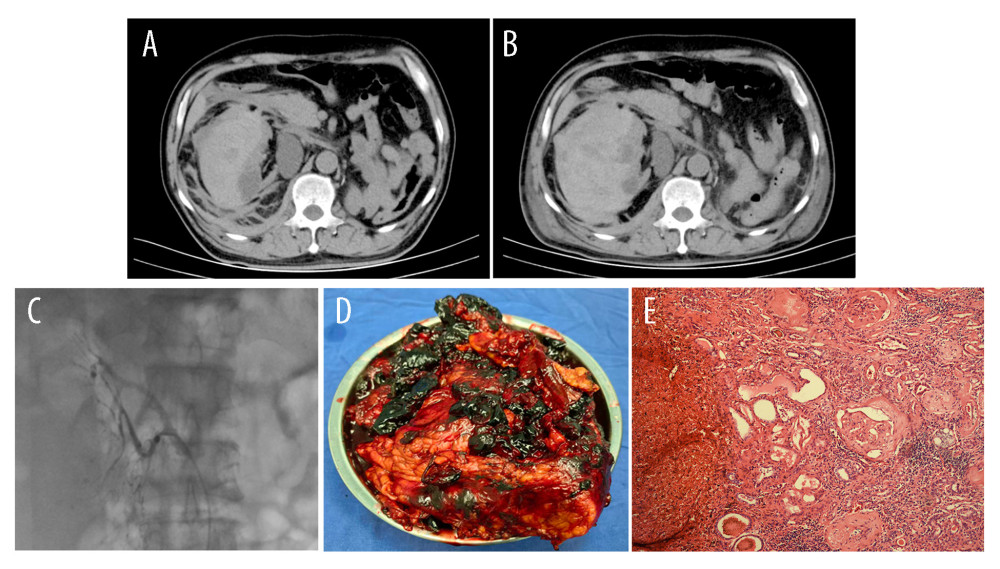
After admission, laboratory tests were performed. Hematological testing showed a red blood cell count of 3.38 × 10¹²/L (4.3–5.8 × 10¹²/L), hemoglobin level of 105 g/L (130–175 g/L), and platelet count of 153 × 109/L (125–350 × 109/L). Coagulation functions (prothrombin time, activated partial thromboplastin time, and fibrinogen) were all within the reference range. Computed tomography (CT) of the upper abdomen demonstrated ACKD, subcapsular hemorrhage around the right kidney, and blood accumulation in the posterior peritoneum (Figure 1A).
After 4 days of conventional therapy, his hemoglobin level dropped to 70 g/L (130–175 g/L). The CT scan of the upper abdomen was re-examined, showing that the volume of the subcapsular hematoma increased (Figure 1B). Digital subtraction angiography was conducted immediately and showed multiple irregular patchy areas of contrast extravasation at the distal end of the right renal artery (Figure 1C). Subsequently, right renal artery embolization was performed.
However, the hemoglobin concentration was still declining and gradually dropped to 56 g/L (130–175 g/L) on the second day following digital subtraction angiography. Therefore, the patient underwent a right nephrectomy. The resected right kidney contained a ruptured and hemorrhagic cyst measuring 14 × 11 cm, with blood clots within the cyst cavity (Figure 1D), confirming spontaneous hemorrhage associated with ACKD. Microscopically, glomerulosclerosis and tubular dilatation were observed in the renal parenchyma surrounding the ruptured hematoma (Figure 1E). Postoperatively, the level of hemoglobin remained stable.
Discussion
This report describes a case of dialysis-associated ACKD presenting with spontaneous hemorrhage. Rapid diagnosis, continuous monitoring, and prompt interventional and surgical treatment were essential to optimize outcomes and prevent mortality. Previous retrospective studies have shown that the most common underlying cause of spontaneous hemorrhage is renal neoplasm (60%–65%), with vascular malformations (20%–30%) also being cited as triggers in the general population [10]. Ruptured renal cyst has also been found to be a cause of spontaneous hemorrhage, accounting for 13.6% of 78 patients during a 13-year period [10]. In a Chinese cohort involving 50 patients with spontaneous hemorrhage, the second most common cause was renal cysts (10 cases, 20%), with 8 ACKD cases and 2 autosomal dominant polycystic kidney disease cases [11]. Among these 10 patients with renal cysts, 9 were patients receiving hemodialysis, which suggests that the incidence of spontaneous hemorrhage caused by ACKD rupture in the hemodialysis population might be higher than that in the general population. This requires further study.
In another study, the prevalence of ACKD was 7% to 22% in the pre-dialysis population, increased to 44% within the first 3 years after the initiation of dialysis, and reached 79% after more than 3 years of dialysis. The prevalence rose to as high as 90% after 10 years on dialysis [6]. ACKD can be complicated by episodes of renal pain, cyst rupture, cyst hemorrhage, and malignant transformation into renal cell carcinoma [12]. Because large hemorrhages can obscure small masses and ruptured cysts, some authors speculated that the cause of spontaneous hemorrhage might be related to the rupture of ACKD. In our study, the patient had ACKD and spontaneous hemorrhage, and the resected kidney showed a ruptured and bleeding area of a cyst, which confirmed that the cause of spontaneous hemorrhage was the rupture of ACKD.
The increased bleeding risk associated with hemodialysis may be explained by platelet dysfunction and impaired platelet–vessel wall interactions. Furthermore, the high prevalence of antiplatelet and anticoagulant drug use could play an important role [2,3]. A previous study has shown that 1 in 7 patients on dialysis might experience a major hemorrhage within 3 years of dialysis initiation [13]. A meta-analysis showed that the risk of cyst bleeding was lower in patients undergoing peritoneal dialysis than in those receiving hemodialysis requiring anticoagulation [14]. Our patient was treated with low-molecular-weight heparin for anticoagulation during hemodialysis. Whether spontaneous hemorrhage in patients receiving hemodialysis was related to the use of anticoagulants remains unclear. Previous studies were mostly small-sample retrospective studies, and it is not yet possible to determine the correlation between the spontaneous hemorrhage and anticoagulants [7,11]. The reasoning for increased bleeding in patients receiving hemodialysis is multifactorial. Overall, a combination of bleeding tendency due to platelet dysfunction from uremia, anticoagulant use, arteriosclerosis, and ACKD rupture leads to spontaneous hemorrhage.
Our patient was admitted to the hospital with severe right lower abdominal and lumbar pain, which is consistent with other similar cases [7–9,15]. After admission, the identification of spontaneous hemorrhage often triggers a CT scan by the emergency room physician. The patient in the present study was diagnosed as having spontaneous hemorrhage after undergoing non-contrast CT examinations. The sensitivity of the diagnosis for spontaneous hemorrhage with CT scan can reach 100% [11]. However, the underlying cause of spontaneous hemorrhage might not be readily apparent on initial non-contrast CT, as large hemorrhages can obscure small masses and ruptured cysts [16]. In a series of 42 patients, a combination of CT and magnetic resonance imaging in the acute setting did not find a cause in 10 patients [17]. Even when a CT angiogram is administered, the mass can still be occult, as it can potentially blend with the enhancing renal parenchyma on a single-phase study, which would affect the diagnosis of etiology. The selection of the examination methods should be based on availability and the patient’s condition and tolerance.
Traditionally, case studies of spontaneous hemorrhage indicate conservative management can be used as a less invasive first-line treatment [7,17]. However, a proportion of patients go on to require invasive treatment [8,9]. Renal artery embolization is safe and effective for controlling spontaneous hemorrhage in patients with ACKD [9]. In a retrospective study including 18 patients with ACKD who underwent renal artery embolization, the clinical success rate was 94% [18]. Open surgical treatment and laparoscopic nephrectomy have been preferred in some cases for patients with persistent hemodynamic instability [15,19]. Both the conservative management and artery embolization with digital subtraction angiography were unsuccessful in our case. Consequently, the patient underwent a right nephrectomy.
Conclusions
This report describes the case of a 68-year-old man with dialysis-associated ACKD presenting with spontaneous intracystic hemorrhage. Dynamic monitoring of hemoglobin levels and imaging follow-up are crucial for the selection of treatment strategies. Surgical intervention was recommended because conservative management and digital subtraction angiography failed to halt the persistent decline of hemoglobin levels.
References
1. Bello AK, Okpechi IG, Osman MA, Epidemiology of haemodialysis outcomes: Nat Rev Nephrol, 2022; 18(6); 378-95
2. Wang Q, Xie X, Xu G, The risk of bleeding for antiplatelet agents in haemodialysis patients: A meta-analysis: BMC Nephrol, 2020; 21(1); 106
3. van Eck van der Sluijs A, Abrahams AC, Rookmaaker MB, Bleeding risk of haemodialysis and peritoneal dialysis patients: Nephrol Dial Transplant, 2021; 36(1); 170-75
4. Shah JN, Gandhi D, Prasad SR, Wunderlich syndrome: Comprehensive review of diagnosis and management: Radiographics, 2023; 43(6); e220172
5. Kim JW, Kim JY, Ahn ST, Spontaneous perirenal hemorrhage (Wunderlich syndrome): An analysis of 28 cases: Am J Emerg Med, 2019; 37(1); 45-47
6. Teuwafeu DG, Dongmo A, Fomekong SD, Acquired cystic kidney disease in patients on maintenance hemodialysis, prevalence and associated factors: A cross-sectional study: Pan Afr Med J, 2023; 45; 175
7. Wood A, Ismail I, Wunderlich’s syndrome in a haemodialysis patient: BMJ Case Rep, 2023; 16(10); e255985
8. Kawahara T, Kawahara K, Ito H, Spontaneous renal hemorrhage in hemodialysis patients: Case Rep Nephrol Urol, 2011; 1(1); 1-6
9. Konno H, Nitta M, Iwafuchi Y, Spontaneous retroperitoneal hemorrhage treated with transcatheter arterial embolization in a patient with acquired cystic kidney disease: A case report: Cureus, 2025; 17(2); e78532
10. Mao Y, De Oliveira IS, Hedgire S, Aetiology, imaging features, and evolution of spontaneous perirenal haemorrhage: Clin Radiol, 2017; 72(2); 175e19-.e26
11. Zhao YL, Jia XY, Tong XQ, Spontaneous renal hemorrhage: A clinical analysis of 50 patients: Chin J Nephrol, 2021; 37(6); 474-80
12. Rahbari-Oskoui F, O’Neill WC, Diagnosis and management of acquired cystic kidney disease and renal tumors in ESRD patients: Semin Dial, 2017; 30(4); 373-79
13. Molnar AO, Bota SE, Garg AX, The risk of major hemorrhage with CKD: J Am Soc Nephrol, 2016; 27(9); 2825-32
14. Zhou C, Gu Y, Mei C, Dialysis modality and mortality in polycystic kidney disease: Hemodial Int, 2018; 22(4); 515-23
15. Kajikawa M, Tanji H, Higashi Y, Spontaneous renal hemorrhage in acquired cystic kidney disease: J Gen Fam Med, 2021; 22(2); 94-95
16. Parmar N, Langdon J, Kaliannan K, Wunderlich syndrome: Wonder what it is: Curr Probl Diagn Radiol, 2022; 51(2); 270-81
17. Elbaset MA, Zahran MH, El-Baz R, Spontaneous renal hemorrhage: Critical analysis of different lines of management in non-traumatic patients: a single tertiary center experience: Int Urol Nephrol, 2020; 52(3); 423-29
18. Chen CS, Ahn H, Shin JH, Renal artery embolization for spontaneous hemorrhage in patients with acquired cystic kidney disease: A 20-year single-center experience: Pak J Med Sci, 2021; 37(4); 1111-17
19. Tao B, Zhang H, Zhang G, Management of nontraumatic spontaneous renal hemorrhage (Wunderlich syndrome) through robotic-assisted laparoscopic nephrectomy: A case series: Am J Case Rep, 2024; 25; e942826
In Press
Case report
Am J Case Rep In Press; DOI: 10.12659/AJCR.953555
Case report
Am J Case Rep In Press; DOI: 10.12659/AJCR.953169
Case report 
Am J Case Rep In Press; DOI: 10.12659/AJCR.954027
Case report
Am J Case Rep In Press; DOI: 10.12659/AJCR.954380
Most Viewed Current Articles
07 Dec 2021 : Case report  28,713,109
DOI :10.12659/AJCR.934347
Am J Case Rep 2021; 22:e934347
06 Dec 2021 : Case report  180,916
DOI :10.12659/AJCR.934406
Am J Case Rep 2021; 22:e934406
21 Jun 2024 : Case report
124,581
DOI :10.12659/AJCR.944371
Am J Case Rep 2024; 25:e944371
08 May 2026 : Case report
95,842
DOI :10.12659/AJCR.952158
Am J Case Rep 2026; 27:e952158