


04 September 2026: Articles 
Left Atrial Thrombectomy Under Cardiopulmonary Bypass Without Aortic Cross-Clamping Using Rapid Ventricular Overdrive Pacing: A Case Report
Unusual clinical course, Challenging differential diagnosis, Diagnostic / therapeutic accidents, Unusual setting of medical care, Educational Purpose (only if useful for a systematic review or synthesis)
Tomohide Takei ACDEF 1*, Takeshi Nagaoka B 2, Hitoshi Sato B 2DOI: 10.12659/AJCR.953416
Am J Case Rep 2026; 27:e953416


Abstract
BACKGROUND: Aortic cross-clamping is usually required to clearly visualize the surgical field in mini-thoracotomy because cardiac surgery without aortic cross-clamping can be challenging. However, certain patients may require alternative strategies for cardiovascular surgeries.
CASE REPORT: We report the case of a 73-year-old woman with prior valve replacement who underwent left atrial thrombectomy under cardiopulmonary bypass without aortic cross-clamping using rapid ventricular overdrive pacing. She was referred to our hospital for an evaluation of elevated C-reactive protein levels. Computed tomography coronary angiography revealed a large non-mobile mass in the left atrium that did not decrease after anticoagulation therapy. A high degree of adhesion was observed around the aortic root, making median sternotomy and aortic cross-clamping hazardous. Thrombectomy during perfused ventricular fibrillation was an option but is associated with other potential complications such as coagulopathy, arrhythmia, hyperglycemia, and disordered electrolytes that could further increase the total risk. Therefore, rapid ventricular overdrive pacing was selected to achieve temporary circulatory arrest, combined with a mini-thoracotomy approach. Rapid ventricular overdrive pacing was successfully maintained throughout the thrombectomy, and the patient was easily weaned from cardiopulmonary bypass. She was extubated in the operating room at the end of the surgery. She recovered without complications and was discharged walking independently.
CONCLUSIONS: Rapid ventricular overdrive pacing to achieve temporary circulatory arrest during cardiovascular surgery may be a new therapeutic option in patients with high risks associated with reoperation.
Keywords: Cardiac Surgical Procedures, Pacemaker, Artificial, Reoperation, Thoracic Arteries, Thrombectomy
Introduction
Patients undergoing reoperation are at a high risk of major bleeding due to adhesions, which can be life-threatening and can limit surgical options [1]. Mini-thoracotomy has emerged as a new approach in cardiac surgery, as the smaller operative field can reduce blood loss and the need for blood transfusions [2–5]. Aortic cross-clamping is usually required to clearly visualize the surgical field. However, it carries a risk of major bleeding, as it requires detachment around the aortic root to create space [6]. Cardiac surgery without aortic cross-clamping is challenging because cardioplegic solutions cannot be used. Therefore, alternative methods of inducing cardiac arrest, such as ventricular fibrillation (VF), or beating-heart surgery are required [6–8]. Both methods typically require placement of a venting catheter in the aortic root and/or left atrium to prevent air embolism and left ventricular distension [6].
We describe the case of a patient who had previously undergone mitral valve replacement and tricuspid valvuloplasty 7 months earlier and required left atrial thrombectomy. Owing to the risks associated with median sternotomy and aortic cross-clamping, we considered several thrombectomy approaches. These included perfused VF induced by moderate hypothermia [9], beating-heart surgery [6], and cardiac arrest using cardioplegic solutions, which would require aortic cross-clamping. However, we opted for rapid ventricular overdrive pacing (RVOP) using a transvenous temporary pacemaker during the thrombectomy. The patient was weaned from the cardiopulmonary bypass, extubated in the operating room, and discharged from the hospital on postoperative day 29 without complications.
To our knowledge, RVOP has not previously been applied during thrombus removal from the left atrium. Herein, we introduce RVOP as an alternative approach when aortic cross-clamping is contraindicated and discuss its feasibility and safety.
Case Report
A 73-year-old woman (height, 153 cm; weight, 42 kg) was referred to our hospital for evaluation of elevated C-reactive protein levels. She had undergone mitral valve replacement and tricuspid valvuloplasty 7 months earlier. Postoperative warfarin had initially been prescribed, but it was replaced with aspirin due to difficulties controlling the prothrombin time/international normalized ratio. Computed tomography (CT) coronary angiography revealed a non-mobile mass in the left atrium (Figure 1). Infective endocarditis and thrombus were considered in the differential diagnoses, and anticoagulation therapy using an amount of unfractionated heparin sufficient to prolong the activated partial thromboplastin time combined with antibiotics was initiated. However, because the mass did not decrease in size and the patient was at risk of embolism, thrombectomy was planned. No thrombus-related complications had developed at that time.
Preoperative contrast-enhanced CT revealed the close proximity of the right coronary artery to the sternum and a high degree of adhesion around the aortic root (Figure 2), which limited exposure of the ascending aorta. The patient was scheduled for reoperation through a right lateral mini-thoracotomy incision without aortic cross-clamping. Venting through the aortic root was restricted because of the adhesions described above. Inserting the catheter directly into the left atrium was also considered risky, as the location of the mass coincided with the intended catheter insertion site (Figure 1). We could not insert a venting catheter or cross-clamp the aorta; thus, we elected to induce cardiac arrest using RVOP via a transvenous temporary pacemaker. This method is usually applied during transcatheter aortic valve replacement (TAVR) to induce transient cardiac standstill and ensure optimal placement of the prosthesis at the aortic annulus [10].
General anesthesia was induced, and the patient was intubated with a double-lumen tracheal tube. A temporary pacemaker was inserted through the right internal jugular vein, and defibrillation pads were placed on the patient’s chest as a precaution. Femoro-femoral normothermic cardiopulmonary bypass was initiated after heparin administration. Perfusion pressure was maintained at > 60 mm Hg. After securing a clear surgical view around the left atrium, the operating table was placed in the Trendelenburg position, and the surgical field was continuously filled with pumped carbon dioxide. We initiated RVOP at 220 bpm with 100% stimulation efficacy. After transesophageal echocardiography confirmed closure of the aortic valve, the left atrium was immediately opened and the thrombus was resected. Rapid pacing was maintained throughout the 18-minute procedure. Real-time transesophageal echocardiography did not detect air in the left ventricle after atrial closure and cessation of rapid pacing. Spontaneous cardiac rhythm subsequently recovered, and the patient was weaned from cardiopulmonary bypass. The total duration of cardiopulmonary bypass was 33 minutes, and the overall surgical duration was 3 hours 21 minutes. The patient was extubated in the operating room without respiratory or circulatory complications. She was ambulatory and discharged home on postoperative day 29. Pathological examination of the resected mass confirmed fresh, sterile thrombi composed of platelets and fibrin. While the exact reason for the thrombus formation in this patient is unclear, it is thought to be attributable to the forced discontinuation of anticoagulants due to poor PT-INR control and the presence of left atrial enlargement.
This patient provided written consent to undergo the described procedures according to local research ethics committee requirements, and the report was prepared in compliance with the relevant “Enhancing the Quality and Transparency of Health Research” case report (“Consensus-Based Clinical Case Reporting Guideline Development”) guidelines.
Discussion
Patients with a history of procedures such as cardiac surgery are at high risk of life-threatening bleeding during reoperation, which can adversely affect perioperative outcomes [1].
Left atrial or ventricular venting is typically required to prevent ventricular distension, particularly when aortic regurgitation (AR) is evident. Venting is also recommended during beating-heart surgery to prevent air embolism through the aortic root [8]. Venting through the aortic root was not feasible in our patient due to the high degree of collusion, and inserting a catheter directly into the left atrium posed additional risk because the thrombus was located near the intended insertion site (Figure 1). Because the left atrium was to be opened during the procedure, air embolism was the main concern rather than left ventricular distension, as AR was not observed. Therefore, complete cardiac arrest was deemed necessary to prevent air embolism. Although we initially considered inducing cardiac arrest via VF, we decided against induced hypothermia considering the short surgical duration and the possibility of complications such as coagulopathy, arrhythmia, hyperglycemia, and a disordered electrolyte balance. However, in the absence of venting catheters, spontaneous recovery from VF could have led to immediate air embolism. Furthermore, without a precipitating factor such as hypothermia, whether VF could be maintained until the end of the procedure remained uncertain.
Transient cardiac standstill can be induced by RVOP using a transvenous temporary pacemaker during TAVR. This is an established procedure that ensures the optimal placement of a prosthesis at the aortic annulus and decreases ventricular filling time, stroke volume, and cardiac output [9,11]. The main advantages of RVOP are simplicity, reliability, and ease of implementation via insertion of a temporary pacemaker through the right internal jugular vein into the right ventricle.
Potential complications associated with RVOP include iatrogenic ventricular fibrillation, procedural hypotension, periprocedural acute kidney injury, atrial fibrillation, and stroke [11]. Although the available data are limited to a few patients with surrogate endpoints, many of these adverse events are likely related to transient hypotension and ischemic myopathy, which can be prevented with cardiopulmonary bypass.
In reporting this case, it must be mentioned that it is a single case, that there is no data on long-term prognosis, and that caution should be taken when making generalizations.
Conclusions
RVOP combined with mini-thoracotomy can provide a relatively safe option for patients undergoing left atrial thrombectomy who are at high risk of major complications associated with traditional methods, such as VF and aortic cross-clamping. Establishing the safety of the method will require accumulation of further data and studies on long-term prognosis.
Figures
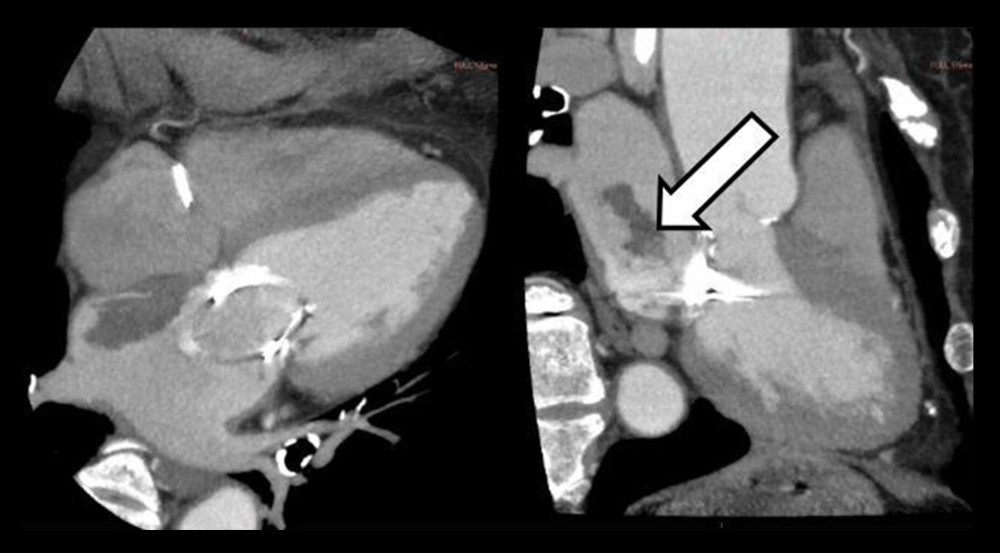 Figure 1. Left and right, prospective axial and sagittal views. Arrows indicate a mass inside the left atrium along the atrial septum.
 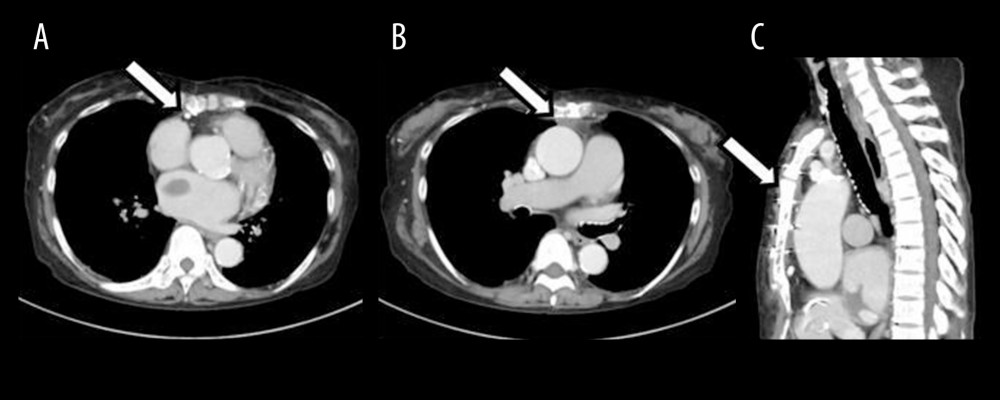 Figure 2. Contrast-enhanced computed tomography images. (A) Arrow indicates the right coronary artery near the back of the sternum. (B, C) High degree of collusion around the aortic root.
 References
1. Umakanthan R, Petracek MR, Leacche M, Minimally invasive right lateral thoracotomy without aortic cross-clamping: An attractive alternative to repeat sternotomy for reoperative mitral valve surgery: J Heart Valve Dis, 2010; 19; 236-43
2. Nakamura T, Izutani H, Sekiya N, Initial experience with beating heart mitral valve repair via mini-thoracotomy at a single institution: Jpn J Cardiovasc Surg, 2014; 43; 58-61
3. Ding C, Jiang DM, Tao KY, Anterolateral minithoracotomy versus median sternotomy for mitral valve disease: A meta-analysis: J Zhejiang Univ Sci B, 2014; 15; 522-32
4. Sündermann SH, Sromicki J, Rodriguez Cetina Biefer H, Mitral valve surgery: Right lateral minithoracotomy or sternotomy? A systematic review and meta-analysis: J Thorac Cardiovasc Surg, 2014; 148; 1989-95e4
5. Kastengren M, Svenarud P, Ahlsson A, Dalén M, Minimally invasive mitral valve surgery is associated with a low rate of complications: J Intern Med, 2019; 286; 614-26
6. Holman WL, Goldberg SP, Early LJ, Right thoracotomy for mitral reoperation: Analysis of technique and outcome: Ann Thorac Surg, 2000; 70; 1970-73
7. Mo A, Lin H, On-pump beating heart surgery: Heart Lung Circ, 2011; 20; 295-304
8. Katircioglu SF, Cicekcioglu F, Tutun U, On-pump beating heart mitral valve surgery without cross-clamping the aorta: J Card Surg, 2008; 23; 307-11
9. Steimle CN, Bolling SF, Outcome of reoperative valve surgery via right thoracotomy: Circulation, 1996; 94(9 Suppl); II126-28
10. Witzke C, Don CW, Cubeddu RJ, Impact of rapid ventricular pacing during percutaneous balloon aortic valvuloplasty in patients with critical aortic stenosis: Should we be using it?: Catheter Cardiovasc Interv, 2010; 75; 444-52
11. Fefer P, Bogdan A, Grossman Y, Impact of rapid ventricular pacing on outcome after transcatheter aortic valve replacement: J Am Heart Assoc, 2018; 7; e009038
Figures
Figure 1. Left and right, prospective axial and sagittal views. Arrows indicate a mass inside the left atrium along the atrial septum.Figure 2. Contrast-enhanced computed tomography images. (A) Arrow indicates the right coronary artery near the back of the sternum. (B, C) High degree of collusion around the aortic root. In Press
Case report 
Am J Case Rep In Press; DOI: 10.12659/AJCR.953543
Case report
Am J Case Rep In Press; DOI: 10.12659/AJCR.954216
Case report 
Am J Case Rep In Press; DOI: 10.12659/AJCR.954932
Case report 
Am J Case Rep In Press; DOI: 10.12659/AJCR.954146
Most Viewed Current Articles
07 Dec 2021 : Case report
28,712,695
DOI :10.12659/AJCR.934347
Am J Case Rep 2021; 22:e934347
06 Dec 2021 : Case report  180,721
DOI :10.12659/AJCR.934406
Am J Case Rep 2021; 22:e934406
21 Jun 2024 : Case report
124,419
DOI :10.12659/AJCR.944371
Am J Case Rep 2024; 25:e944371
08 May 2026 : Case report
95,462
DOI :10.12659/AJCR.952158
Am J Case Rep 2026; 27:e952158